
Button Nose vs Other Nose Shapes: Side-by-Side Comparison
Most people cannot tell a button nose from a snub nose just by looking in the mirror. This guide fixes that.

Quick Summary
Not sure which nose shape you have? A button nose has three defining traits: a small rounded tip, a low smooth bridge, and a gentle upward tilt. This guide compares that structure against 11 other shapes — snub, bulbous, Roman, Greek, flat, hawk, nubian, aquiline, straight, fleshy, and hooked — using tip direction, bridge height, and forward projection as reference points throughout. Use the 3-step method above the table to identify your nose shape before reading the individual comparisons below.
Why These Nose Shapes Get Confused
Most people cannot tell the difference between a button nose and a snub nose at a glance. They look similar — both small, both compact — but the structural difference becomes clear once you know what to look for. The same confusion happens with button vs bulbous, button vs flat, and button vs straight.
Each pair shares surface-level similarities but differs in three specific ways: tip direction, bridge height, and forward projection. Understanding what a button nose actually is — its defining features, proportions, and structure — makes every comparison on this page easier to follow.
This guide compares a button nose against 11 other common shapes using those same three reference points throughout. By the end, you will know exactly which category your nose falls into — no guesswork needed.
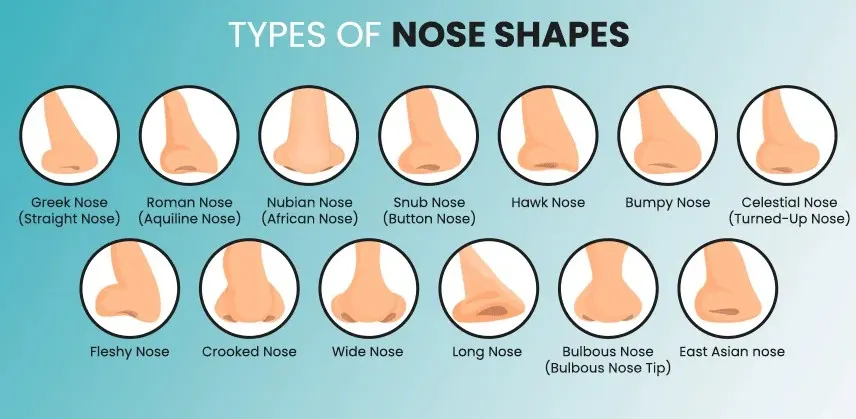
How To Identify Your Nose Shape (3-Step Method)
Before comparing shapes, use these three checkpoints on your own nose. You will need a mirror and a side-profile photo if possible.
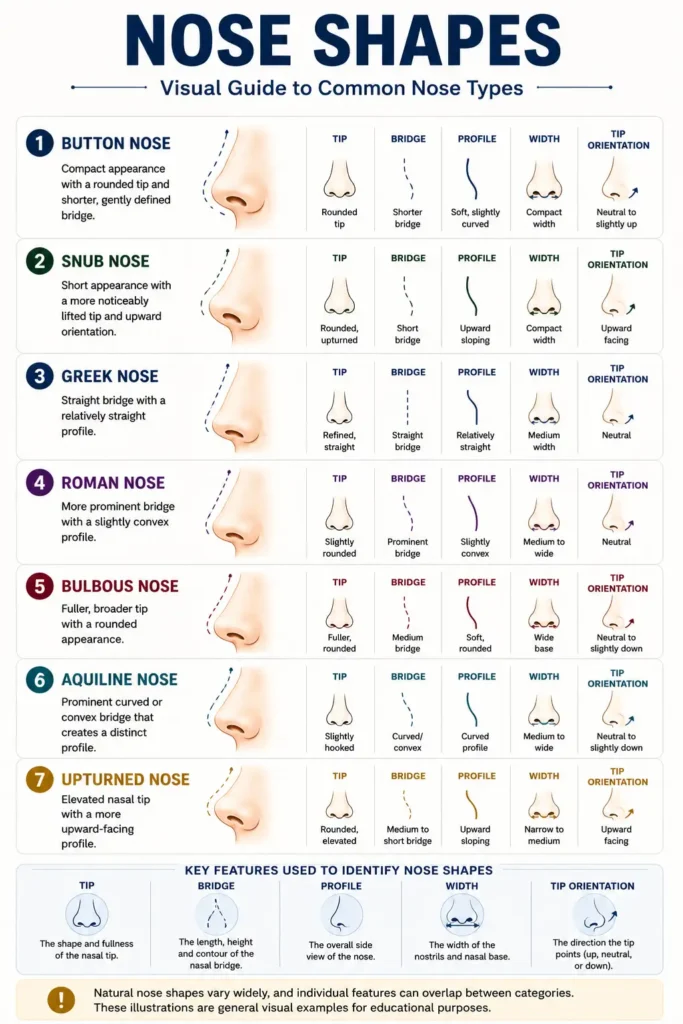
Step 1 — Look at the Tip
Stand in front of a mirror. Is your nasal tip small, rounded, and compact? Does it sit neatly without appearing wide or heavy? If yes, you are likely looking at a button nose or snub nose. If the tip appears wide, fleshy, or dominant — move to bulbous, flat, or fleshy on the comparison table below.
Step 2 — Look at the Bridge
Take a side-profile photo. Does your bridge sit low and smooth, flowing quietly from forehead to tip? That is the button nose bridge. To understand exactly how the bridge and cartilage structure work together, the button nose anatomy guide breaks this down in detail. If you see an outward curve or bump along the dorsum — that points toward Roman or aquiline. If the bridge curves downward toward the lip — that is hawk or hooked.
Step 3 — Check the Tip Direction
Still in profile — does your tip point slightly upward? That is the clearest sign of a button nose. If the tip points straight forward with no curve, that is a straight nose. If it points downward toward the upper lip, that is hawk or hooked. If it turns up sharply — more than yours — that is a snub nose.
Quick Result Guide
- Rounded tip + low bridge + slight upward tilt → Button Nose
- Rounded tip + low bridge + sharp upward tilt → Snub Nose
- Wide tip + low bridge + flat projection → Flat or Bulbous Nose
- Defined tip + straight bridge + no curve → Straight or Greek Nose
- Any tip + downward curve on bridge → Hawk, Hooked, or Roman Nose
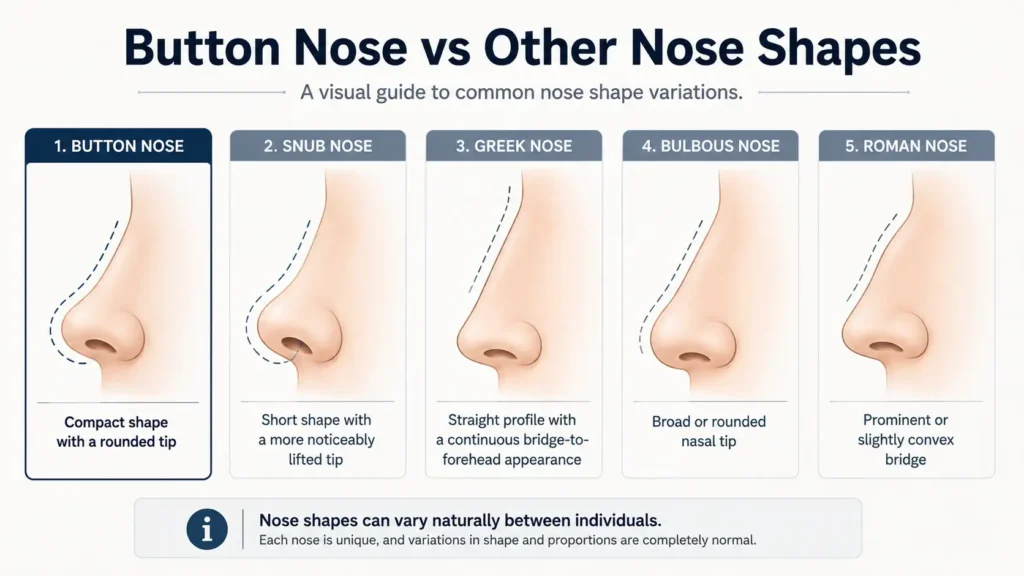
Button Nose vs 11 Nose Shapes — Comparison Table
Now that you have identified your general category, use the table below to pinpoint the exact shape. Each row highlights the single structural trait that separates that shape from a button nose most clearly.
| Nose Shape | Tip Style | Bridge Type | Key Difference from Button Nose |
|---|---|---|---|
| Button | Small, rounded, soft | Short and low | The reference point — petite, gently upturned |
| Snub | Sharply upturned | Concave or curved | Higher nostril visibility, more aggressive upward tilt |
| Bulbous | Wide and fleshy | Wide | Apex is fuller and heavier overall |
| Roman | Defined | Outward curve | Prominent dorsal bump visible in side profile |
| Greek | Narrow | Perfectly straight | Linear from forehead to nasal point, no curve |
| Flat | Broad and soft | Very low | Minimal forward projection from the face |
| Hawk | Downward point | Long and curved | Dorsum and apex both curve toward the lips |
| Nubian | Wide and thick | Wide base | Greater horizontal nostril width |
| Aquiline | Refined | Gentle outward curve | Longer and more projecting than Roman |
| Straight | Defined point | Straight | No upward curve at the nasal apex |
| Fleshy | Thick and large | Wide and full | Heavy lower portion with visible soft tissue |
| Hooked | Downward angle | Sharp curve | Apex hooks noticeably toward the chin |
Detailed Comparisons
Button Nose vs Snub Nose
Tip direction is the first place to look. A button nose has a soft, gently upturned apex with a nasolabial angle typically between 95 and 110 degrees. A snub nose sits higher on that scale, often above 110 degrees. That higher angle produces a sharper upward tilt and makes the nostrils more visible from the front.
The bridge also differs between the two. A button nose keeps a low, even bridge line that flows smoothly from the forehead to the nasal point. A snub nose tends to have a concave upper section that reinforces the upward curve in profile. Both types are compact and short — but the snub shape reads as more aggressively turned up, while the button nose turns up gently.
Not sure which one you have? If your nostrils are clearly visible from the front and your tip feels like it tilts sharply upward, that is more likely snub. If the tilt is subtle and the nostrils are not especially visible head-on, that is button. The full button nose vs snub nose comparison covers tip rotation, bridge shape, and profile structure in detail.
Button Nose vs Bulbous Nose
Tip size creates the clearest difference here. A button nose has a small, neat apex that stays in proportion with the bridge and nostrils. A bulbous nose has a wider, heavier lower portion. It often appears fuller than the rest of the structure. This extra volume at the lower portion is the defining visual trait of the bulbous shape.
Skin thickness also plays a role. Bulbous noses typically have thicker soft tissue over the nasal apex. This softens the underlying cartilage and makes the lower portion appear larger. A button nose looks smooth and contained from the front — the proportions stay balanced, with the tip never dominating the overall structure.
If your tip feels wider or heavier than the rest of your nose when you look straight into a mirror, bulbous may be the closer match. See the full button nose vs bulbous nose comparison with structural visuals.
Button Nose vs Roman Nose
The dorsum is where these two types diverge most clearly. A button nose keeps a short, smooth upper section that stays close to the face. A Roman nose features a prominent outward curve along the dorsum. That curved bump is the defining trait of the Roman shape and makes it immediately recognizable in a side view.
Length also sets them apart. A button nose is short from top to tip and does not project far forward. A Roman nose appears longer and extends further from the facial plane. In profile, a button nose creates a soft, subtle outline. A Roman nose creates a strong, curved silhouette.
The easiest test: look at yourself from the side. If your bridge is completely smooth with no bump, that is button. If you see a clear outward curve or bump along the upper bridge, that points to Roman. Read the full button nose vs Roman nose comparison to understand the structural and visual differences.
Button Nose vs Greek Nose
Dorsum alignment is the main point of contrast. A button nose has a low bridge and a rounded, soft apex. A Greek nose has a perfectly straight dorsum from forehead to tip — no bumps or curves appear along the way. That clean linear structure is what makes the Greek nose immediately distinctive in profile.
The tip also differs between the two. A Greek nose typically ends in a narrow, well-defined point. A button nose ends in a rounder, softer point. From the side, a Greek nose forms a clean straight line from top to bottom. A button nose shows a shorter profile with a gentle upward curve near the tip.
If your bridge is completely straight but your tip is rounded and soft rather than narrow and defined, you may fall somewhere between these two categories. The full button nose vs Greek nose comparison explains the structural and visual differences clearly.
Button Nose vs Flat Nose
Projection marks the clearest difference between these two. A button nose extends slightly forward from the face and has a defined rounded apex. A flat nose stays very close to the facial plane, with minimal depth from front to back. This difference is most visible in a side-profile photo.
Width also varies between the two types. A flat nose often appears broader across the nostrils. A button nose keeps a more contained horizontal width. Both have low bridges — but a button nose shows some forward movement and a distinct curved apex. A flat nose shows very little depth and a dorsum that sits nearly level with the surrounding face.
The simplest test is a side-profile photo. If you see almost no forward projection and your bridge appears nearly level with your cheeks, flat is the likely match. Read the full button nose vs flat nose comparison for a complete structural breakdown.
Button Nose vs Hawk Nose
Dorsum curvature creates the strongest contrast between these two. A button nose has a short, smooth upper section with a slight upward tilt at the nasal point. A hawk nose has a long upper section that curves downward toward the tip — a shape often compared to a bird’s beak.
Apex direction also separates them clearly. A hawk nose points downward toward the upper lip. A button nose points upward or stays level. From the side, a button nose forms a soft, compact outline. A hawk nose creates a pronounced downward curve that starts high on the dorsum and extends toward the lower face. These two shapes are among the most visually opposite on this list.
Button Nose vs Nubian Nose
Width and projection are the two clearest differences. A button nose is compact and sits close to the face, with a narrow overall width. A Nubian nose often features a longer dorsum and a noticeably wider base at the nostrils. This horizontal width is one of the primary identifying traits of the Nubian shape.
The lower portion also differs between the two. A Nubian nose may show a downward or forward-leaning tip. A button nose keeps a rounded nasal point with a subtle upward turn. From the front, a Nubian nose occupies more horizontal space across the face. A button nose stays narrow and centered.
Button Nose vs Aquiline Nose
Bridge shape creates the clearest contrast here. A button nose has a short, low bridge that stays smooth. An aquiline nose features a longer upper section with a gentle outward curve, often described as resembling an eagle’s profile. That curved silhouette is most visible from the side.
Length also differs between the two. A button nose stays compact from top to bottom. An aquiline nose is longer and projects further from the brow line. In profile, an aquiline nose creates a flowing outward curve along the dorsum. A button nose keeps the outline shorter, softer, and more recessed. The aquiline and Roman shapes are often confused — but the aquiline curve tends to be more refined and less abrupt.
Button Nose vs Straight Nose
A straight nose follows a linear path from dorsum to nasal point — no bumps or curves appear along the way. A button nose breaks that straight line with a rounded apex and a slight upward turn. This creates a noticeably softer look compared to the clean angles of a straight shape.
Bridge height also varies between the two. A straight nose often has a more defined and higher dorsum that starts near the forehead. A button nose keeps the upper section lower and less prominent. From the side, a straight nose forms a sharp, linear angle. A button nose shows a softer curve near the tip and a shorter overall length. If your nose appears perfectly linear in profile but ends in a rounded tip rather than a defined point, you may have traits of both.
Button Nose vs Fleshy Nose
Volume creates the main difference. A button nose has a compact, neat tip that appears firm and well-defined. A fleshy nose has a thicker, fuller lower portion with more visible soft tissue. This extra fullness comes from a higher concentration of fatty tissue over the nasal cartilage.
The lower third of a fleshy nose tends to draw more attention due to its size. A button nose keeps the lower portion subtle and narrow. From the front, a fleshy nose appears broader across the base. A button nose stays contained and centered on the face. Both types can have low bridges — the tip volume is what separates them.
Button Nose vs Hooked Nose
Upper section direction is the first thing to compare. A button nose has a smooth, short upper section that stays level. A hooked nose features a bridge that curves downward toward the tip — a shape often compared to a curved beak.
Tip direction contrasts sharply between the two. A hooked nose points toward the upper lip. A button nose stays level or turns slightly upward. In profile, a hooked nose creates a noticeable downward curve. A button nose maintains a gentle, rounded outline with a short overall length. Like the hawk nose, a hooked shape is visually opposite to the button — the downward direction of both the bridge and the tip is the defining giveaway.
Which Nose Shape Do You Have?
After working through the three identification steps and the comparisons above, most people land clearly in one category. The most common points of confusion are button vs snub (tip tilt degree), button vs bulbous (tip weight and width), and button vs flat (forward projection).
If you have confirmed your nose is a button nose and want to understand its full structure — the cartilage, the nasal tip anatomy, and what gives it its distinctive shape — the button nose anatomy guide covers all of that in detail.
If you are still unsure between two shapes after reading this page, the individual comparison pages listed throughout go deeper into each pairing with more specific structural criteria.