
Button Nose Rhinoplasty: Surgical Options & What to Expect

Quick Summary
Button nose rhinoplasty reshapes the nasal tip, bridge, or nostril base to create a compact, rounded, and gently upturned profile. Most cases require tip work only. The goal is proportion — not maximum reduction. Results are
permanent, with the nasal tip taking up to twelve months to fully settle. This page covers surgical options, cost, candidacy, recovery, and non-surgical alternatives.
| DISCLAIMER: This article is for educational purposes only and does not constitute medical advice. Always consult a qualified medical professional before making health decisions. |
Button nose rhinoplasty is a surgical procedure that reshapes the nasal tip, bridge, or nostril base to create a compact, rounded, and gently upturned profile. The goal is not to make the nose dramatically smaller. It is to adjust specific structural proportions — tip projection, nasolabial angle, and bridge height — so the nose reads as balanced and softly defined. Results are permanent, and the procedure is typically performed under general anesthesia in one to three hours.
What Button Nose Rhinoplasty Actually Changes
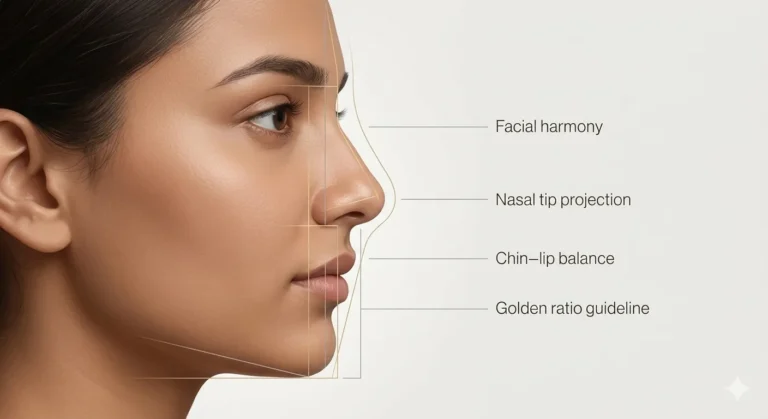
A button nose is defined by three structural traits: a soft domed apex, a low-to-moderate bridge, and a nasolabial angle between 95 and 110 degrees. Rhinoplasty aimed at achieving this profile works on those same three elements. Surgeons do not follow a single template. They evaluate what already exists and identify which adjustments will bring the nose into the target range without disrupting facial balance.
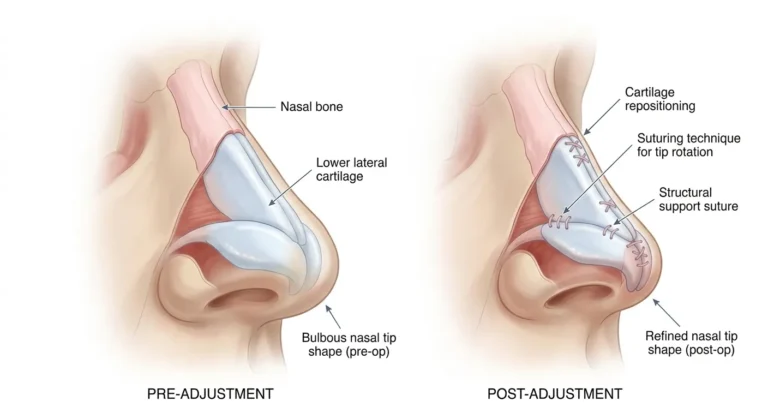
Nasal tip reshaping is the most common focus. The lower lateral cartilages — the paired cartilages that form the nasal tip — are repositioned, trimmed, or supported using suture techniques to create a rounder, softer apex. When the tip already has reasonable projection but sits too flat or too downturned, rotation sutures raise it into the 95 to 110 degree nasolabial angle range. This single adjustment often accounts for most of the visible change.

Bridge height plays a secondary role. A nose with a moderately high dorsum can appear less compact even when the tip shape is correct. In some cases, minor dorsal reduction brings the bridge into proportion with the tip, reinforcing the overall compact appearance. This is not always necessary. Many button nose rhinoplasty procedures are tip-only, leaving the bridge untouched. Understanding the full button nose anatomy — how cartilage, bone, and soft tissue interact — makes this distinction clearer before any surgical consultation.
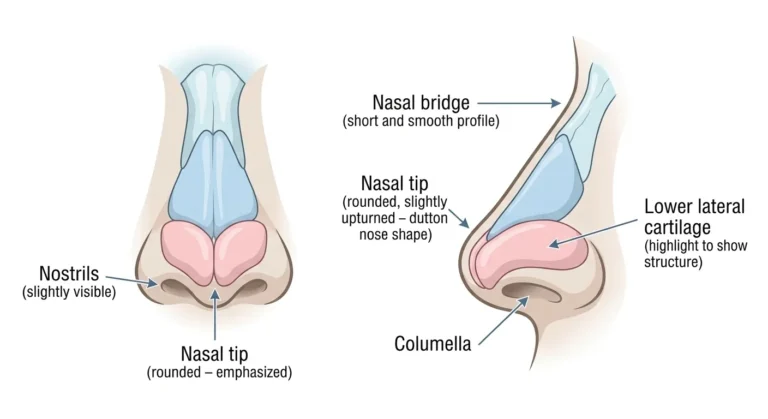
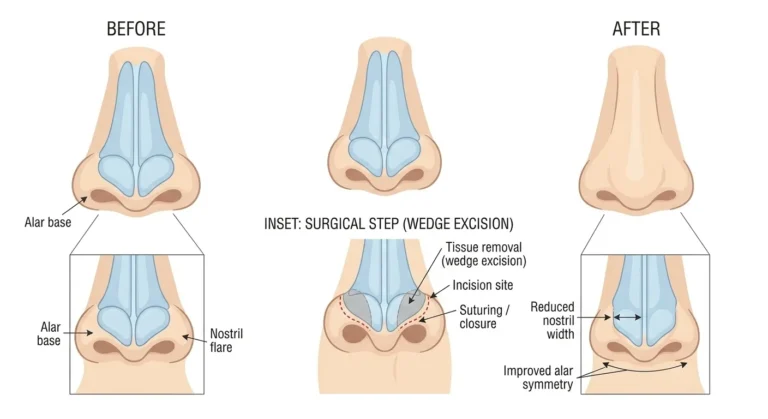
Nostril width is the third variable. A compact tip on a nose with wide nostrils can appear disproportionate. Alarplasty — a separate procedure that reduces nostril width by removing a small wedge of tissue at the alar base — is sometimes combined with tip rhinoplasty to complete the proportional adjustment. It can also be performed independently. The scope depends on existing anatomy, not on a standard formula.
The Goal Is Proportion, Not Reduction
This is the distinction most people miss when researching button nose rhinoplasty. The procedure is not about making the nose as small as possible. Noses that are surgically reduced beyond their structural limits — cartilage cut away beyond what is stable — tend to collapse over time, lose their natural movement, and require revision. The best results maintain enough structural integrity that the nose continues to look natural at every angle, in every expression, and in every decade of life.
Natural rhinoplasty trends in 2026 reflect exactly this shift. The American Society of Plastic Surgeons reports that consultation conversations now focus increasingly on what to preserve rather than what to remove. Surgeons who specialize in nasal aesthetics describe the ideal outcome as a nose that looks proportional to the patient’s face, ages gracefully, and does not appear operated on. For button nose rhinoplasty specifically, this means achieving the compact, rounded profile through precise structural adjustment — not aggressive reduction.
Surgical Approaches Used in Button Nose Rhinoplasty
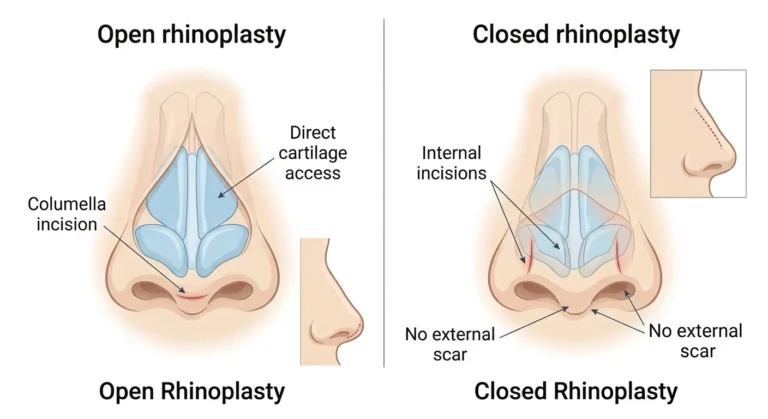
Two surgical approaches exist for accessing nasal structures during rhinoplasty. The choice between them affects visibility, healing time, and the scope of what a surgeon can achieve. Neither approach is universally better. The right choice depends on what the nose needs and how much access the surgeon requires to make precise adjustments. A dedicated comparison of both approaches is covered in the open vs closed rhinoplasty guide.
Open Rhinoplasty
Open rhinoplasty involves a small incision across the columella — the strip of tissue between the nostrils — in addition to internal incisions. This approach lifts the skin away from the nasal framework, giving the surgeon direct visual access to the tip cartilages and bridge. For button nose work that requires precise tip reshaping, cartilage grafting, or correction of asymmetry, open rhinoplasty provides the visibility needed to make controlled, accurate adjustments. The columellar scar is small and fades significantly within a year. Swelling takes longer to resolve than with the closed approach.
Closed Rhinoplasty
Closed rhinoplasty keeps all incisions inside the nostrils, leaving no external scars. The surgeon works without fully lifting the skin away from the nasal structures. This approach suits cases where the adjustments are more limited — subtle tip rotation, minor dorsal reduction, or fine-tuning rather than rebuilding. Recovery tends to be faster and swelling resolves sooner. For straightforward tip rotation into the button nose range, some surgeons prefer this approach when anatomy allows.
Procedures Commonly Included in Button Nose Rhinoplasty
Button nose rhinoplasty is not one fixed procedure. It is a goal-directed plan that may include one procedure or several, depending on the starting anatomy. The procedures below are the most common components. Each is covered in detail in its dedicated guide.
Tip Rhinoplasty
Tip rhinoplasty reshapes the lower lateral cartilages to create a softer, rounder, and more defined nasal apex. It is the most frequently performed component of button nose surgery and can be done as a standalone procedure when the bridge and nostrils are already proportionate. Surgeons use a combination of cartilage trimming, dome-binding sutures, and tip rotation techniques to achieve the domed, gently upturned apex that defines this nose shape. The full tip rhinoplasty guide covers techniques, costs, and recovery in detail.
Alarplasty
Alarplasty narrows the nostril base by removing a small, precisely measured wedge of tissue at the point where the nostril meets the cheek. The result is a reduction in alar width that brings the nostrils into proportion with a refined tip. The procedure is permanent, takes under an hour, and leaves scars in the natural crease at the nostril base where they are difficult to detect. It is often combined with tip rhinoplasty but can also be performed independently when tip shape is not a concern. The alarplasty guide explains candidate criteria and what the procedure involves.
Dorsal Reduction
When the bridge sits higher than the target proportions for a button nose profile, minor dorsal reduction smooths and lowers the nasal bridge without removing structural support. This is less commonly required for button nose rhinoplasty than tip work, since the button nose naturally has a low-to-moderate bridge. When the bridge is disproportionately high relative to the tip, a small reduction brings the overall profile into balance.
Who Is a Suitable Candidate for Button Nose Rhinoplasty
Candidacy for rhinoplasty depends on physical and anatomical factors, not on appearance alone. Facial growth must be complete — typically by age 17 to 18 for women and slightly later for men — before the nasal structure is stable enough for permanent surgical changes. Operating on a nose that is still developing risks results that shift as the face continues to grow. Full candidacy criteria are covered in the button nose rhinoplasty candidates guide.
Skin thickness is a significant anatomical variable. Thicker skin over the nasal tip makes it harder for refined cartilage work to show through clearly. The improvement is still real, but the visible effect of tip refinement is more subtle on noses with thick soft tissue coverage. Surgeons assess skin thickness during consultation because it directly affects how much change is achievable and how long swelling takes to resolve.
Realistic expectations are the other core requirement. Button nose rhinoplasty adjusts proportions within the limits of existing anatomy — it does not transplant a different nose onto a face. Patients who approach surgery with a specific structural goal, understood in the context of their own facial geometry, consistently report better satisfaction than those who bring photos of another person’s nose as the target outcome.
How Much Does Button Nose Rhinoplasty Cost
The average cost of rhinoplasty in the United States is $7,637 according to the American Society of Plastic Surgeons. This figure covers the surgeon’s fee only. Total costs including anesthesia, operating facility fees, pre-operative assessments, and follow-up appointments typically bring the full price to between $10,000 and $15,000 in major metropolitan areas. Tip rhinoplasty performed as a standalone procedure costs less — national averages for tip plasty range from $4,750 to $14,225 depending on complexity and location.
Geographic location is one of the strongest cost variables. Practices in New York, Los Angeles, and other high-cost cities charge more than those in smaller markets. Surgeon experience and board certification also affect pricing significantly. A surgeon who specialises specifically in rhinoplasty and performs high volumes of the procedure will typically charge more than a generalist — and the outcomes in a technically demanding procedure like nasal tip refinement tend to reflect that difference. Full cost breakdowns by procedure type and country are covered in the button nose rhinoplasty cost guide.
Insurance does not cover cosmetic rhinoplasty. When surgery is performed to correct a functional issue — a deviated septum causing breathing obstruction, for example — the functional component may qualify for partial coverage. The cosmetic portion remains an out-of-pocket expense regardless. Most practices offer financing options for patients who plan payment over time.
What to Expect During Recovery
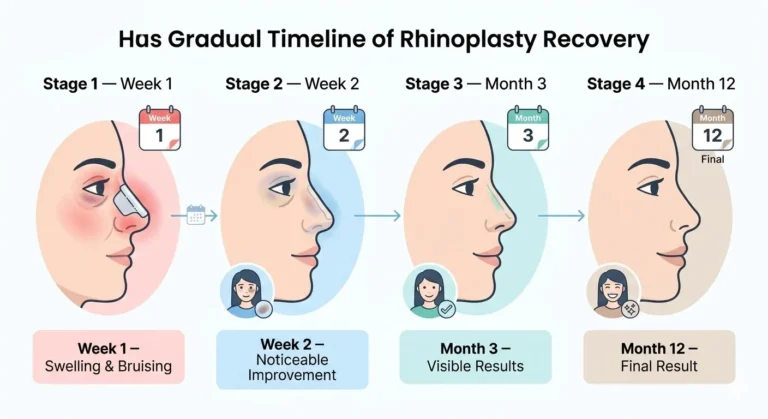
The first week after button nose rhinoplasty involves a nasal splint, swelling, and bruising around the nose and under the eyes. Most patients return to desk work within seven to ten days. Strenuous exercise, contact with the nose, and wearing glasses resting on the bridge are restricted for four to six weeks. The splint is typically removed at the one-week post-operative appointment.
Swelling resolves in stages. The majority of visible swelling clears within two to three months. The nasal tip — which has the thickest concentration of soft tissue — is the last area to fully settle. In some cases, subtle tip refinement continues for up to twelve months as tissue gradually adapts to its new position. This staged resolution is normal and not a sign of a problem. Recovery timelines, activity restrictions, and what the healing process looks like week by week are covered in the button nose rhinoplasty recovery guide.
Non-Surgical Alternatives
Not everyone considering a button nose profile wants surgery. Non-surgical rhinoplasty — most commonly using hyaluronic acid filler — can adjust the appearance of the nasal tip and bridge without incisions or general anesthesia. The results are temporary, lasting between twelve and eighteen months depending on the filler used and individual metabolism. Filler cannot reduce size or change the nasolabial angle structurally. It works by adding volume strategically to create an optical illusion of better proportion.
Makeup contouring and nose tape are two further non-surgical options that affect appearance without any medical intervention. These create temporary visual adjustments with no recovery time and no medical risk. None of these alternatives produce permanent structural change. They are meaningful options for people who want to explore the aesthetic before committing to surgery, or who prefer a non-permanent approach entirely. All non-surgical options are covered in the non-surgical button nose options guide.
How to Approach the Decision
Button nose rhinoplasty is one of the most technically demanding procedures in facial plastic surgery. The nasal tip involves paired cartilages, soft tissue layers, and a complex interplay of structure and skin that vary significantly between individuals. Small changes at the tip produce visible effects across the entire face. This is why surgeon selection matters more here than in almost any other cosmetic procedure.
A consultation with a board-certified facial plastic surgeon or plastic surgeon who specialises in rhinoplasty is the starting point. During consultation, the surgeon will assess your nasal anatomy, discuss what is structurally achievable, and explain which procedures apply to your specific case. No general guide — including this one — can substitute for that individual evaluation. What this guide provides is the foundational understanding to enter that conversation prepared.
After examining hundreds of nose shape comparisons across this site, one pattern becomes consistently clear: the button nose profile works because of proportion, not size. The surgical goal that produces the most natural, lasting results is always proportion first — not the smallest nose possible, but the most balanced one.