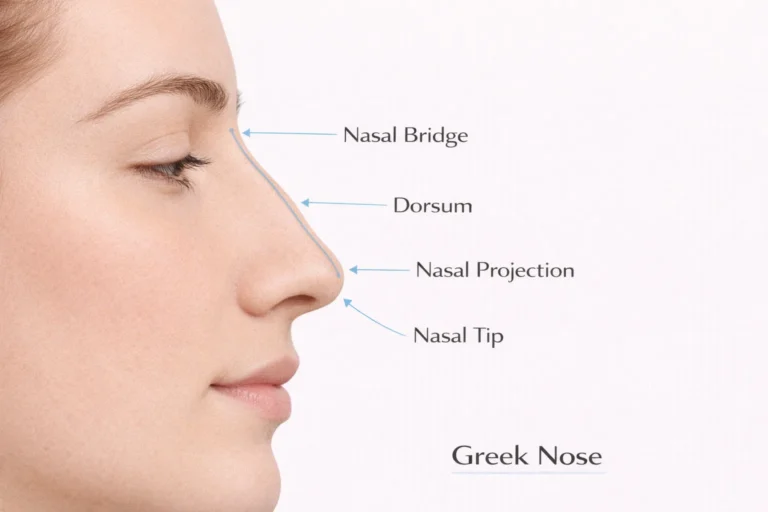
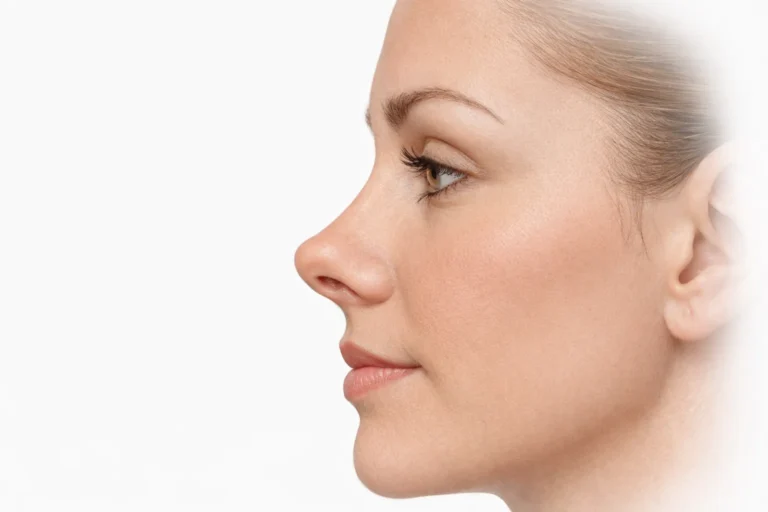
A Barbie nose is a social-media label for a small, narrow nose with a slightly upturned tip and a smooth, low bridge. It is not a medical or surgical classification. Facial plastic surgeons describe the underlying anatomy as increased nasal tip rotation combined with a reduced dorsal profile — the same variables used in standard rhinoplasty planning. Two people can start with very different noses and both end up with a result reasonably called a “Barbie nose,” because the term describes an outcome, not a fixed set of measurements.
Where the Term Comes From
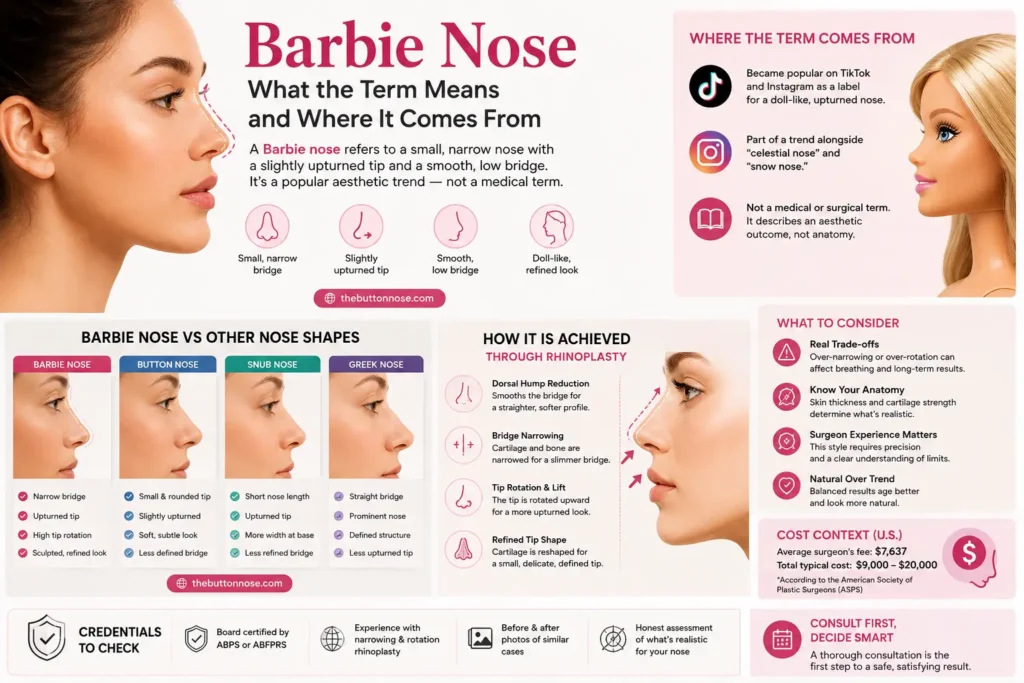
The phrase spread through TikTok and Instagram as a shorthand for a doll-like nose: small, tightly refined, and lifted at the tip. It sits alongside other informal labels like “celestial nose” and “snow nose,” all pointing at variations of the same upturned look. None of these are terms a surgeon would find in a textbook. They are consumer shorthand for a specific aesthetic goal, useful for describing what a patient wants, not for describing anatomy on their own.
Barbie Nose vs. Recognized Nose Shape Categories
The look most people mean by “Barbie nose” overlaps closely with what is formally called an upturned or celestial nose shape, covered alongside other nose shape categories on our types of noses guide. Where it differs is emphasis: a Barbie nose leans harder into a narrow, sculpted bridge and a pronounced tip lift than a typical upturned nose does. It also shares ground with a snub nose, which is shorter with a naturally upturned tip, though a snub nose tends to keep more width at the base rather than the narrowed bridge people associate with the trend. Readers weighing the distinction between related shapes can see a direct side-by-side on our button nose vs. snub nose comparison.
How the Look Is Achieved
Some people are born with this nose shape, a product of genetics rather than any procedure. For readers pursuing the look surgically, it typically involves a combination of dorsal hump reduction, cartilage narrowing at the bridge, and tip rotation to lift the endpoint upward. Surgeons can approach this through either open or closed rhinoplasty technique, depending on how much structural change the nose needs. The narrower a bridge is taken and the higher a tip is rotated, the more the result depends on the patient’s own skin thickness and cartilage strength to hold that shape over time.
What This Style of Rhinoplasty Involves
Aggressive narrowing and over-rotation carry real trade-offs. Reducing the internal nasal passageway too much can affect breathing, and a tip rotated past a natural range can read as an obviously operated-on result rather than a refined one. A surgeon experienced in this specific style will typically flag a candidate’s skin thickness and bone structure before agreeing to chase a highly narrowed outcome. This is a consultation question worth raising directly, not something to leave until after surgery is booked.
Cost Context
The American Society of Plastic Surgeons reports an average rhinoplasty surgeon’s fee near $7,637, with total primary procedure costs typically running $9,000 to $20,000 nationally once anesthesia and facility charges are included. A narrowing-and-rotation style rhinoplasty sits within that same national range, though complexity can push a quote toward the higher end since more structural work is usually involved than in a standard reduction. Treat any number here as a planning range, not a fixed quote — an in-person consultation is what produces an accurate figure for a specific nose.
Credentials to Check Before Considering This Look
Look for board certification through the American Board of Plastic Surgery or the American Board of Facial Plastic and Reconstructive Surgery before booking a consultation. Ask specifically how many narrowing-and-rotation cases a surgeon has performed, since this style demands more precision than a general reduction rhinoplasty. A board-certified surgeon should be willing to show relevant before-and-after examples and explain why a given result would or would not suit your anatomy.
FAQ
Is “Barbie nose” a real medical term?
No. It is a social-media description, not a clinical classification used by surgeons. The anatomy it describes — a narrowed bridge and an upturned, rotated tip — maps onto standard rhinoplasty terminology, which is what a surgeon will actually use during a consultation.
What’s the difference between a Barbie nose and a button nose?
A button nose is small and slightly upturned with a rounded tip and softer overall shape. A Barbie nose pushes further toward a narrowed, sculpted bridge and a more pronounced tip lift, making it a more stylized, higher-rotation variation rather than a separate shape category.
How much does this type of rhinoplasty cost?
Nationally, primary rhinoplasty typically runs $9,000 to $20,000, based on American Society of Plastic Surgeons data, with an average surgeon’s fee near $7,637. A narrowing-and-rotation result often lands toward the higher end of that range because of the added structural work involved.
What should I ask a surgeon before pursuing this look?
Confirm board certification through the American Board of Plastic Surgery or the American Board of Facial Plastic and Reconstructive Surgery. Ask how many narrowing-and-rotation cases they’ve performed specifically, and how your own skin thickness and cartilage strength affect what’s realistic.
Can this nose shape look natural over time?
It can, when the narrowing and rotation stay within a range the patient’s own anatomy supports. Overly aggressive changes are more likely to shift or reveal themselves as surgical over time, which is part of why surgeon experience with this specific style matters.