
Are Button Noses Attractive? What the Science Actually Says About This Nose Shape
Most sources give you a one-word answer. This page gives you the research behind it — and what it actually means for your face.
Quick Summary
Yes, button noses are widely considered attractive. Research in facial psychology links this shape to three specific and documented traits: perceived youthfulness driven by the baby-face effect, facial symmetry that keeps the eyes and lips as the primary focal points, and approachability tied to the rounded nasal structure. These are not cultural opinions. They are patterns identified across multiple psychological studies. Cultural preferences vary — Western and East Asian beauty standards arrive at the same conclusion through different reasoning — but the underlying psychology is consistent. This page explains each factor in detail, including how attractiveness changes based on face shape and whether the same perception applies to men.
Are Button Noses Considered Attractive?
Yes. A button nose is considered attractive across multiple cultural and psychological frameworks. The shape — defined by a small rounded tip, a short low bridge, and a subtle upward tilt at the nasal apex — aligns with three traits that facial perception research consistently links to positive aesthetic judgment: youthfulness, balance, and approachability.
This is not a matter of trend or personal preference alone. Psychologists and facial surgeons have studied nasal aesthetics specifically, and the structural features of a button nose appear repeatedly in findings about what makes a face appealing across different cultures and demographics. Understanding what a button nose is and what defines its structure makes the research easier to follow.
The more precise question is not whether this shape is attractive — it is why, and whether that attractiveness holds across all faces, genders, and cultural contexts. Those answers are more nuanced than a simple yes.
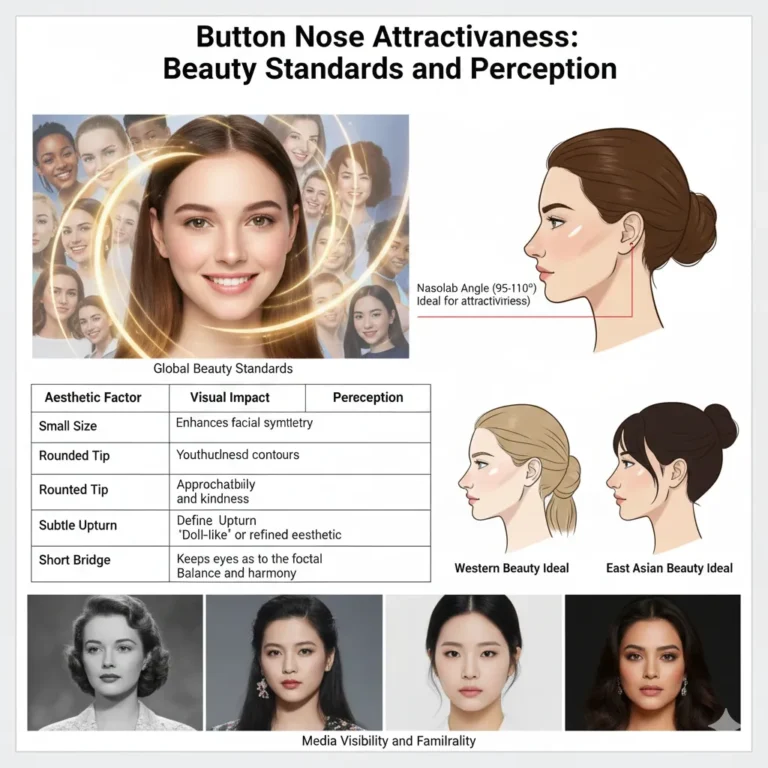
| Aesthetic Factor | Visual Impact | Psychological Perception |
|---|---|---|
| Small Size | Enhances facial symmetry | Youthfulness and charm |
| Rounded Tip | Softens facial contours | Approachability and kindness |
| Subtle Upturn | Defines the side profile | Refined, balanced aesthetic |
| Short Bridge | Keeps eyes as focal point | Harmony across features |
What Does the Science Say About Button Nose Attractiveness?
Facial psychology research identifies three specific mechanisms that explain why this nose shape is perceived positively. Each one operates independently — together, they create a consistent pattern across studies.
The Baby-Face Effect
The first mechanism is the baby-face effect. Human brains are wired to respond positively to infant-like facial features. This is an evolutionary response tied to caregiving instincts. When infant-like features appear on an adult face, the brain triggers an automatic positive response — associating the person with warmth, trustworthiness, and approachability.
A button nose closely resembles the nasal structure seen in infancy: small, rounded, with a low bridge and soft tip. Psychologists Leslie Zebrowitz and Joann Montepare documented this pattern formally in 2008. Their research showed that adults with childlike facial features are automatically perceived as warmer and more trustworthy — not because of conscious judgment, but because of a fast cognitive response that bypasses deliberate thinking.
This response does not require cultural exposure. It operates below conscious awareness and has been documented across different cultural groups.
Facial Symmetry and Proportion
The second mechanism is proportional balance. A compact nose with a short bridge takes up less visual space than more prominent nasal shapes. This allows the eyes and lips to remain the dominant focal points of the face. Aesthetic traditions across multiple cultures interpret this kind of proportional harmony as visually appealing because the nose complements rather than competes with the other features.
To understand how the specific structures of this shape — the cartilage, the tip anatomy, and the bridge — create these proportions, the button nose anatomy guide covers this in full structural detail.
The Nasolabial Angle
The third mechanism is geometric. Facial surgeon Bahman Guyuron identified the nasolabial angle — the angle formed between the base of the nose and the upper lip in side profile — as one of the most studied measurements in facial aesthetics. Research points to an angle between 95 and 110 degrees as the range rated most favorably in women. For men, the preferred range sits slightly lower, between 90 and 95 degrees.
A button nose naturally falls within or near the female ideal range. That geometric alignment helps explain its consistent showing in facial aesthetics research. Angles below 90 degrees make a nose appear downturned and heavy in profile. Angles above 115 degrees make the tip look overly rotated. This shape sits in the measured range between those two extremes.
Are Button Noses Attractive on Men Too?
Yes, but the perception differs from how it applies to women. The research context matters here.
For women, a button nose aligns directly with the 95 to 110 degree nasolabial angle that Guyuron’s research identifies as the most favorably rated range. The baby-face effect also applies more strongly in female facial perception research, where rounded, compact features score higher in approachability ratings.
For men, the preferred nasolabial angle sits lower — between 90 and 95 degrees — meaning a slightly less upturned tip reads as more proportionate on a male face. A button nose on a man can still fall within this range, but the perception depends more heavily on overall facial structure. On a face with strong jawline definition or prominent cheekbones, a compact nose provides contrast that many people find appealing. On a softer facial structure, the combination can read as less defined.
The key distinction is this: on women, a button nose is independently associated with positive aesthetic judgment. On men, it works best in combination with facial features that provide structural contrast. Neither reading makes it unattractive — the mechanism simply differs.
Does a Button Nose Look Attractive on Every Face Shape?
Not equally on every face — but it works well on most. The reason comes down to how a compact nose interacts with the proportions of different face shapes.
Oval and Heart-Shaped Faces
A button nose works most consistently on oval and heart-shaped faces. These face shapes already carry balanced proportions — wider at the forehead or cheekbones and narrower at the jaw. A compact nose with a short bridge reinforces this balance by keeping the center of the face understated, which draws attention upward to the eyes.
Round Faces
On round faces, a button nose can blend into the overall softness of the face. This is not inherently unattractive — it creates a cohesive, gentle appearance. However, it means the nose contributes less structural contrast than it would on an angular face. People with round faces who have a button nose often find that contouring around the nose and cheekbones creates more visible definition.
Square and Oblong Faces
On square or oblong faces with strong angular features, a button nose provides a notable contrast between the soft nasal structure and the harder jaw or forehead lines. Many people find this combination appealing because it creates visual variety across the face. The nose does not compete with the stronger features — it offsets them.
Long Faces
On longer faces, a short bridge nose can appear proportionate because it does not add vertical length to the profile. This is one of the structural reasons a button nose photographs well across a range of face shapes — its compact vertical dimension adapts to different proportions without dominating.
Is a Button Nose Attractive Across All Cultures?
This nose shape appears as a preferred feature in several distinct cultural traditions, but the reasons differ by region. It is not universally preferred in every culture — but it recurs consistently enough that the psychological mechanisms behind it appear to cross cultural boundaries.
East Asian Beauty Standards
East Asian beauty ideals place strong emphasis on subtle, balanced facial features. A smaller nose with a low bridge and rounded tip fits well with traditional concepts of proportion and femininity in South Korea, Japan, and China. The Korean entertainment industry has brought particularly wide global visibility to this aesthetic. Media platforms regularly feature artists and public figures with compact, symmetrical facial features, reinforcing the preference for balanced profiles among audiences worldwide.

Western Beauty Ideals
Western standards have shifted several times across the past century. Stronger, more angular nasal profiles dominated earlier ideals in film and fashion. The mid-20th century brought a clear change. Audrey Hepburn and Brigitte Bardot helped establish the small, gently upturned nose as a Hollywood ideal, closely linking it with femininity and charm through the 1950s and 1960s. The 1980s and 1990s shifted attention toward bolder profiles. Then the global rise of K-beauty in the 2010s reversed that direction again.
Today this shape is frequently described as photogenic and remains one of the most consistently requested profiles in rhinoplasty consultations in Western markets. Western ideals are increasingly diverse, but this profile has maintained consistent visibility across every major shift in the past seventy years.

Why It Recurs Across Cultures
The recurrence of this shape across different cultural standards points back to the psychological mechanisms described above. The baby-face effect and the nasolabial angle research are not culturally specific findings — they appear across different demographic groups. Cultural standards build on top of those underlying psychological patterns rather than replacing them. That is why a nose shape can be preferred in Seoul, Los Angeles, and London for different stated reasons while the underlying mechanism remains the same.
Why Does Media Exposure Reinforce the Attractiveness of This Shape?
Media shapes what people recognize and discuss in facial features through a documented psychological pattern called the mere exposure effect. When a trait appears often on admired public figures, it gains familiarity. Familiarity then increases how appealing people find it — not because they are told to find it appealing, but because repeated exposure creates a sense of ease and recognition.
Compact, rounded nasal features have maintained steady visibility across film, television, fashion photography, and social media for decades. The K-beauty movement of the 2010s created a strong global surge of interest in these traits. Social media expanded that reach far beyond traditional audiences, exposing viewers worldwide to a consistent set of facial ideals linked to youthfulness and balance.
This does not mean media created the preference. It means media reinforced a preference that already had psychological roots. The mere exposure effect amplifies existing tendencies rather than creating new ones from nothing.

Does Having a Button Nose Affect How People See Themselves?
How a person feels about a facial feature often connects to how closely it aligns with local beauty norms. People whose features match dominant cultural standards tend to receive more positive social feedback over time. Those with this nose shape often receive comments about looking youthful or approachable. Repeated positive feedback can strengthen a person’s self-image around that feature.
It is worth being precise about what the research actually shows. The psychological perception studies document how observers respond to this shape — not what it means about the person who has it. Perceived approachability is a judgment made by the observer, not a characteristic of the individual. Understanding this distinction matters for how people interpret both compliments and cultural standards around facial features.
Personal values and identity matter far more than any single facial trait. Beauty standards continue to evolve toward facial harmony — how all features work together — rather than isolated traits. No single feature defines attractiveness, and no feature defines a person’s worth.
Will the Button Nose Stay Attractive as Beauty Standards Change?
Beauty ideals do not stay fixed — they move with culture, media, and shifting social values. This shape has moved in and out of the spotlight across different decades. It has never fully left mainstream beauty conversations.
The reason it persists is rooted in the psychology described above rather than in trend cycles. The baby-face effect, the nasolabial angle preference, and the proportional balance mechanism are not fashion-dependent. They are documented patterns in human facial perception that predate modern media and recur across cultures that developed independently of each other.
Short-term trend cycles affect which specific features receive the most attention in any given decade. They do not override the underlying psychological patterns that make certain structural features consistently well-regarded. Youthfulness and visual balance outlast individual trends because they are rooted in how human brains process faces — not in what a particular industry decided to promote in a specific year.
The snub nose is the shape most frequently compared to a button nose in attractiveness discussions — both are compact and upturned, but they differ in the degree of rotation and how that plays into the nasolabial angle research described above.