Quick Summary
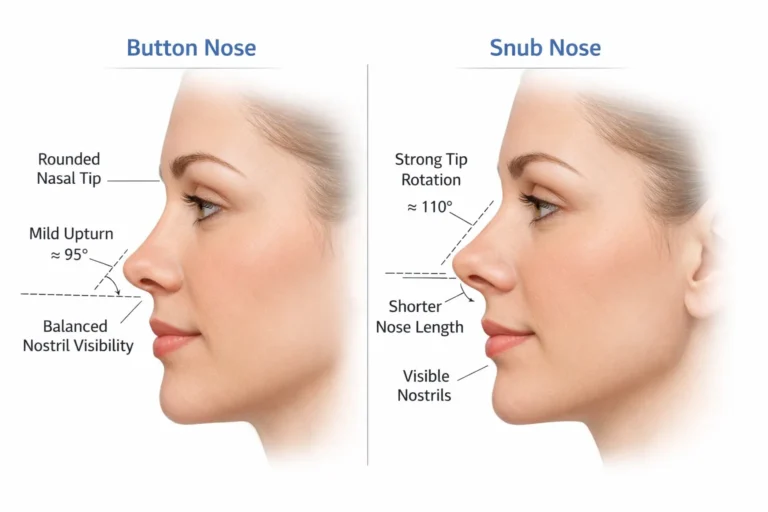
A button nose and a Roman nose sit at opposite ends of the nose shape spectrum in several key ways. A button nose is compact, rounded at the tip, and carries a gentle upward rotation. A Roman nose is longer, projects more from the face, and features a prominent or convex nasal bridge. Both shapes are natural anatomical variations that appear across many different individuals and backgrounds. The differences between them are structural and reflect inherited traits rather than any hierarchy of appearance. This comparison is part of a wider set of structural breakdowns covered in the button nose vs other nose shapes guide.
What Is a Button Nose
A button nose is defined by a rounded nasal tip, a compact overall length, and a gentle upward rotation at the tip. The nasal bridge sits low to moderate and follows a smooth, even line from the nasal root to the tip. There are no significant humps or dramatic curves along the dorsal line. The bridge transitions naturally into the rounded tip without any abrupt change in direction.
The defining combination of traits is the rounded tip paired with a short, compact profile. The nose does not project dramatically from the face. It sits close to the face plane while still maintaining a defined and proportionate shape. Nostril visibility from the front is modest, with the nostrils partially visible due to the gentle upward rotation of the tip.
Button noses appear across many individuals and age groups. They are found across a wide range of ethnic backgrounds and facial types. The shape is one of the most commonly referenced nose types in facial anatomy education and reflects one natural point on the broad spectrum of human nasal variation.
What Is a Roman Nose
A Roman nose is defined by a prominent nasal bridge that often shows a convex curve along the dorsal line. The bridge rises and arches outward before descending toward the tip. This creates a strong, defined silhouette when viewed from the side. The nasal length on a Roman nose tends to be longer than average. The overall profile is bold and angular compared to more compact shapes.
Projection on a Roman nose is typically significant. The nose extends noticeably from the face plane. The tip may point straight ahead or angle slightly downward. It does not carry the upward rotation seen on a button nose. The tip on a Roman nose tends to be more defined and angular rather than soft and rounded.
The convex bridge is the most distinctive feature of the Roman nose. It creates a visible arch along the profile that makes the shape immediately recognizable from the side. This arch varies in degree between individuals. Some Roman noses show a subtle curve. Others show a more pronounced convex ridge that sits clearly above the surrounding bridge line.
Key Structural Differences
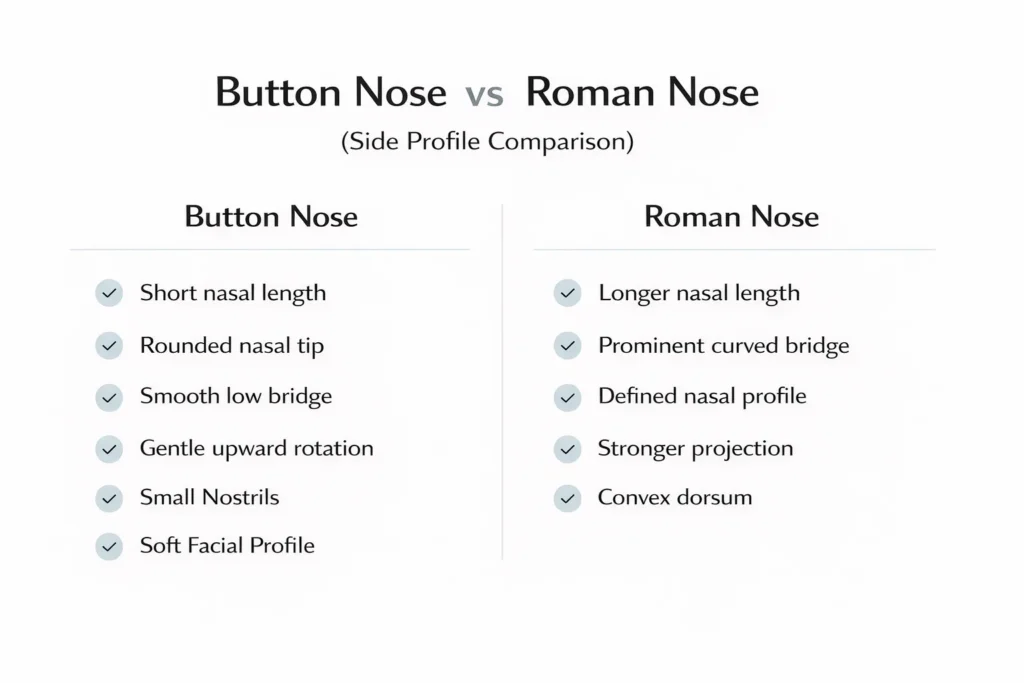
The differences between a button nose and a Roman nose become clear when comparing their structural traits directly. Bridge shape is the most immediate point of contrast. A button nose carries a smooth, low to moderate bridge with no significant arch. A Roman nose carries a convex bridge that curves outward, creating a visible ridge in the profile.
Tip shape also differs significantly. A button nose has a rounded, soft tip that curves gently upward. A Roman nose has a more defined tip that points straight ahead or slightly downward. The tip on a Roman nose does not carry upward rotation. It tends to appear more angular and projected.
Overall nasal length separates these two shapes clearly. A button nose is compact and short. A Roman nose is longer, with a greater distance between the nasal root and the tip. This length contributes to the stronger projection and more prominent profile presence of the Roman nose.
Profile curvature runs in opposite directions between the two shapes. A button nose curves upward at the tip. A Roman nose curves outward and sometimes downward along the bridge. These opposing curves create entirely different side-view silhouettes. Viewing both shapes side by side in profile makes the structural contrast immediately apparent.
Side Profile Comparison
The profile view is where the distinction between these two shapes is most visible. A button nose in profile appears short and compact. The bridge follows a low, smooth path. The tip then curves gently upward, giving the nose a soft, lifted appearance. The overall silhouette is small and close to the face.
A Roman nose in profile looks entirely different. The bridge rises from the nasal root and then arches outward along the dorsal line. The nose extends further from the face, creating a more prominent presence in the side view. The tip sits at the end of this longer structure, pointing forward or slightly downward.
Camera angle and lighting can affect how prominent each feature appears in photographs. A button nose may appear slightly more projected under certain lighting conditions. A Roman nose may appear more or less curved depending on the angle of the shot. A true side-profile photograph in natural light gives the most accurate structural reading for both shapes.
Why These Nose Shapes Develop
Both nose shapes develop through inherited biological factors. Genetics determine the nasal bone length, cartilage structure, and soft tissue distribution that give each nose its shape. A longer nasal bone contributes to the extended profile seen on a Roman nose. A shorter nasal bone contributes to the compact length of a button nose.
The shape of the nasal cartilages determines tip direction and bridge curvature. On a Roman nose, the upper lateral cartilages and nasal bones develop with a convex arch. On a button nose, the lower lateral cartilages are set at an upward angle that produces the characteristic rounded, upturned tip.
Facial growth patterns during development further shape how these features align with the surrounding facial skeleton. The same genetic instructions can produce different results depending on how surrounding bone and tissue structures develop during growth. This explains why nose shapes vary even between close relatives who share similar genetic backgrounds.
How Facial Features Affect the Way Each Shape Reads
The surrounding facial structure changes how both shapes are perceived. A button nose on a longer, narrower face can appear more prominent than the same nose on a wider, rounder face. The face shape creates a frame, and the nose reads differently depending on that frame.
A Roman nose on a broader face may appear more balanced because the strong bridge has more facial width to sit within. On a narrower face, the same Roman nose can appear more dominant because the bridge projection has less surrounding structure to absorb it visually.
Forehead height and brow projection both play a role in profile perception. A strongly projecting brow can make a Roman nose appear slightly less dramatic in profile because the brow draws some of the viewer’s attention. A flatter forehead offers less visual competition, and the convex bridge becomes the leading feature in the profile silhouette.
Chin projection also affects balance. A button nose paired with a recessed chin can appear slightly more forward than it actually is. A Roman nose paired with a strong, forward chin reads as a more balanced profile because the chin provides a counterpoint to the prominent bridge. These relationships between features are normal aspects of facial proportion and not indicators of any structural concern.
Skin thickness affects both shapes. Thicker skin softens the definition of the Roman nose bridge curve and rounds out the tip further on a button nose. Thinner skin reveals more underlying structure, making the convex arch of a Roman nose more sharply defined and the rounded tip of a button nose more clearly contoured.
Can a Roman Nose and Button Nose Look Similar
Some noses show characteristics that fall between these two shape categories. A nose may carry a slightly raised or curved bridge while still maintaining a rounded, upward-pointing tip. In this case, the nose shares traits with both the button nose and the Roman nose without fitting cleanly into either category.
Lighting and camera angle also affect perception. A button nose photographed from below may appear to have a more prominent bridge than it actually does. A Roman nose photographed from above may appear more compact than its true profile. These perceptual effects do not change the underlying structure but can make identification from photographs more challenging.
Nose shapes exist on a spectrum of variation. Many individuals have noses that blend traits from multiple categories. Shape classification serves as a useful reference framework rather than a rigid system of fixed types. The types of noses overview provides helpful context for understanding how all nose shapes relate and overlap across this spectrum.
Frequently Asked Questions
What is the main difference between a button nose and a Roman nose? The clearest difference is bridge shape and nasal length. A button nose has a smooth, low to moderate bridge and a compact overall length. A Roman nose has a convex or arching bridge that curves outward and a longer overall profile. The tip direction also differs. A button nose tip points gently upward. A Roman nose tip points forward or slightly downward.
Can someone have traits of both a button nose and a Roman nose? Yes. Some noses carry a slightly raised or curved bridge while still showing a rounded, upward-pointing tip. This places the nose in a transitional zone between the two categories. Nose shapes exist on a spectrum, and not every nose fits cleanly into one classification. Mixed traits are common and completely normal.
Is a Roman nose more common in certain ethnicities? A convex nasal bridge appears more frequently in certain populations, including people of Mediterranean, Middle Eastern, and South Asian descent. However, it is not exclusive to any group and appears across many different backgrounds. A button nose also appears across all ethnic groups and populations. Both are normal expressions of inherited nasal structure.
Does a Roman nose become more prominent with age? Nasal structure remains largely stable through adult life. However, soft tissue changes gradually with age. The tip may lose some support over time, which can cause it to appear to drop slightly in some individuals. This is a normal aging process and not specific to Roman noses alone. The underlying bone and cartilage structure does not change significantly.
Is a button nose considered small compared to a Roman nose? A button nose is generally more compact in length and sits closer to the face than a Roman nose. However, size is relative and depends on the individual’s overall facial proportions. A button nose on a smaller face may read as proportionate, while a Roman nose on a larger face may also read as proportionate. Neither shape is objectively small or large without the context of the surrounding facial structure.
Why does a Roman nose look so different from the side compared to the front? The convex bridge of a Roman nose creates its most dramatic visual impact in the side view, where the arch is fully visible. From the front, the Roman nose may appear relatively normal in width and tip shape. The profile is where the structural difference becomes most apparent. A button nose shows the opposite tendency. Its compact length and upward tip rotation are both visible from the front and the side.
Are button noses and Roman noses both considered normal? Yes. Both are natural anatomical variations that develop through inherited biological factors. Neither shape indicates a structural problem or irregularity. They simply reflect different expressions of normal human nasal anatomy.
Key Takeaway
A button nose and a Roman nose are structurally distinct shapes that differ in bridge shape, tip direction, nasal length, and projection. A button nose is compact with a rounded tip and a gentle upward rotation. A Roman nose is longer with a convex or arching bridge and a more prominent profile presence. Both shapes are normal anatomical variations that develop through genetics and biological growth.
Understanding these structural differences helps with accurate nose shape identification. For a broader comparison of how the button nose differs from other nose shapes beyond the Roman nose, the button nose vs other nose shapes page covers those comparisons in full detail. For a deeper look at the button nose shape itself, the button nose types guide explains all natural variations within the category.