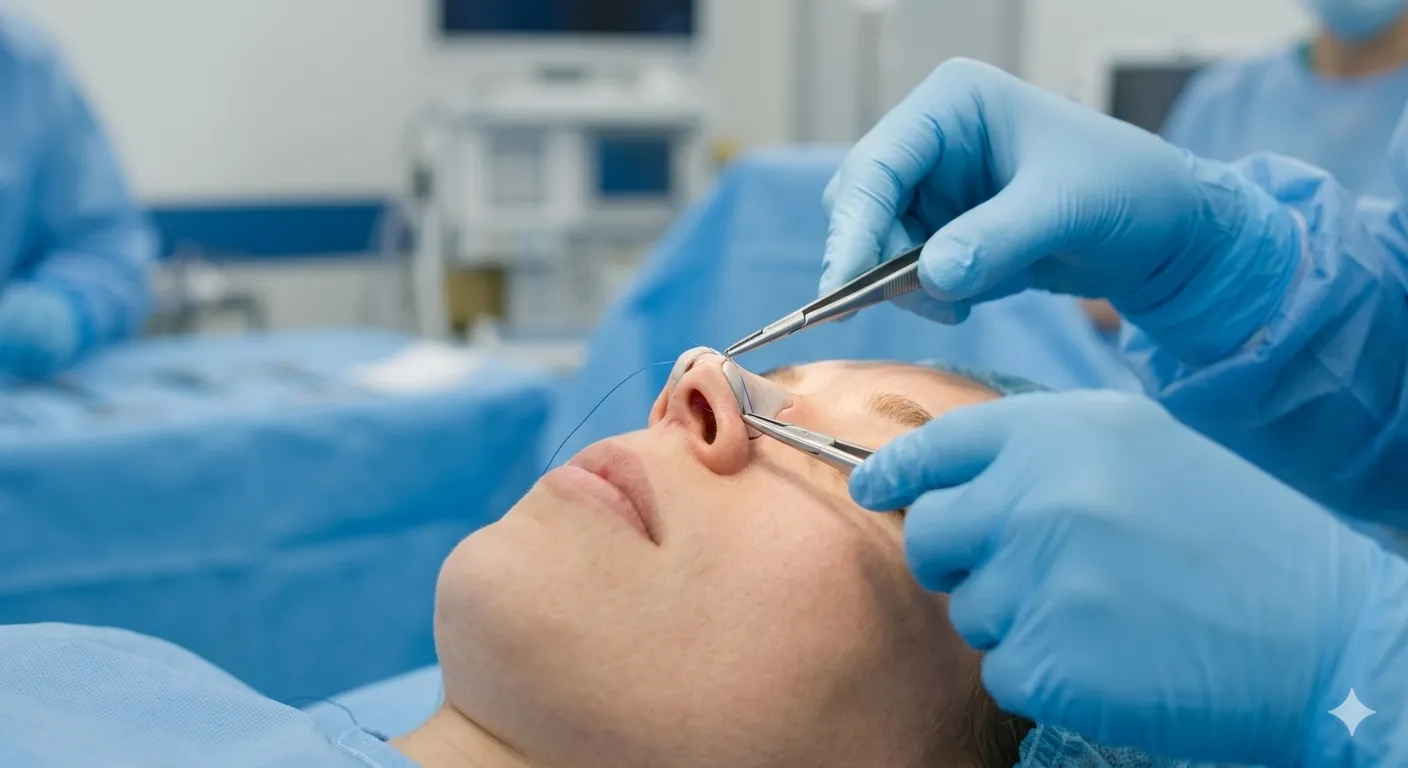
Tip rhinoplasty is a surgical procedure that reshapes the nasal tip without altering the bridge or nasal bones. For a button nose profile, the goal is a soft, domed apex with a nasolabial angle between 95 and 110 degrees — the gentle upward tilt that defines this shape. The procedure targets the lower lateral cartilages using suture techniques, grafts, or careful cartilage reshaping depending on the anatomy. It takes one to two hours and produces permanent results.
What Tip Rhinoplasty Actually Changes
The nasal tip is formed by the lower lateral cartilages — two paired arch-shaped cartilages that determine the width, height, rotation, and definition of the nasal apex. Tip rhinoplasty works exclusively on this lower third of the nose. The bridge, nasal bones, and upper lateral cartilages are left untouched unless the surgical plan specifically includes them as part of a broader procedure. For most button nose cases, the bridge is already low and proportionate — tip work alone addresses the defining characteristics of this profile. Understanding the full structural anatomy behind this is covered in the button nose anatomy guide.
Three variables in the lower lateral cartilages determine how the tip looks: projection, rotation, and definition. Projection is how far the tip extends from the face. Rotation is the angle at which the tip points — the nasolabial angle. Definition is how clearly the apex is shaped and separated from the surrounding tissue. A button nose requires moderate projection, a rotation angle of 95 to 110 degrees, and a soft, rounded definition. Tip rhinoplasty adjusts whichever of these three variables is outside the target range for a given patient’s anatomy.
The Most Important Distinction in Tip Rhinoplasty — Preservation Over Removal
Most descriptions of tip rhinoplasty focus on cartilage removal — trimming away tissue to reduce the size of the tip. This approach dominated the field for decades and remains commonly described in patient-facing content. The current standard of care among rhinoplasty specialists in 2026 has shifted toward cartilage preservation. Surgeons now prefer to reshape the lower lateral cartilages using suture techniques and structural grafts rather than cutting tissue away.
The reason is structural integrity. The lower lateral cartilages provide support for the nasal tip — they keep the apex in position, maintain airway patency, and determine how the nose ages over decades. Removing cartilage weakens this support structure. Over time, tips that have been aggressively reduced can collapse, lose their shape, or drop. Revision tip rhinoplasty — which is more complex and more expensive than primary surgery — most commonly addresses overcorrection from earlier cartilage removal techniques. Surgeons who approach tip rhinoplasty with a preservation-first mindset produce results that are more durable, more natural in appearance, and less likely to require revision. This is the distinction most patient-facing content still does not explain clearly.
Techniques Used in Button Nose Tip Rhinoplasty
The surgical technique used depends on the starting anatomy — what the cartilages look like, how strong they are, what angle they currently sit at, and how much adjustment is needed to reach the target profile. A skilled surgeon selects from a range of techniques rather than applying a single approach to every case.
Dome-Binding Sutures
Dome-binding sutures are the most commonly used technique for tip refinement and rotation in button nose rhinoplasty. A suture is placed through the dome region of the lower lateral cartilage — the highest point of the arch — pulling the two cartilages closer together. This narrows the tip, improves definition, and can slightly increase the nasolabial angle to achieve the upward rotation that characterises a button nose. The technique involves no cartilage removal. It works by repositioning existing cartilage into a better structural alignment. Results from dome-binding sutures are predictable and stable because the underlying cartilage remains intact.
Tip Rotation Sutures
When the nasolabial angle sits below the target range — producing a tip that points too far downward — tip rotation sutures adjust the angle directly. These sutures connect the tip cartilages to the caudal septum or other stable structures, physically rotating the nasal tip upward to bring it into the 95 to 110 degree range. This technique is what produces the defining upward tilt of a button nose when it is not present in the starting anatomy. It is a suture-based approach that does not require cartilage to be removed.
Columellar Strut Graft
A columellar strut is a thin piece of cartilage — typically harvested from the nasal septum — placed between the two lower lateral cartilages in the columella, the tissue strip between the nostrils. It functions as a support structure that stabilises the nasal tip and allows sutures to work more effectively. Without adequate structural support, the tip cartilages can shift over time as healing progresses. The columellar strut prevents this by giving the lower lateral cartilages a stable foundation. It is commonly used in button nose tip rhinoplasty when the existing cartilage lacks the rigidity needed to hold suture adjustments reliably.
Cartilage Trimming — When It Is Used
Selective cartilage trimming is appropriate in specific cases — when the lower lateral cartilages are genuinely oversized, creating a wide or bulbous tip that cannot be adequately refined through sutures alone. The operative word is selective. Only the excess portion is addressed. Removing cartilage beyond what structural integrity allows introduces instability that can manifest years after surgery. When trimming is necessary, it is performed in combination with suture techniques and grafts to ensure the remaining cartilage is well-supported. Trimming alone, without supporting the remaining structure, is the approach most associated with revision cases.
Tip Graft
A tip graft is a small piece of cartilage placed at the nasal apex to add definition, projection, or roundness to the tip. For button nose work, a shield-shaped or round tip graft can soften a pointed apex and create the domed, rounded appearance that defines this profile. The cartilage is typically taken from the septum. Tip grafts are more commonly used in closed rhinoplasty approaches where direct visualisation of the cartilage is limited, giving the surgeon an additional tool for precision shaping.
Open vs Closed Approach for Tip Rhinoplasty
Both open and closed rhinoplasty approaches can be used for tip work, and the choice depends on how much access is needed to execute the surgical plan accurately. A full comparison of both approaches is in the open vs closed rhinoplasty guide.
Closed rhinoplasty — with all incisions inside the nostrils — suits tip cases where the adjustments are straightforward and the cartilages are reasonably cooperative. Recovery is faster, swelling resolves sooner, and there is no external scar. Some surgeons prefer this approach for isolated tip rotation and dome refinement when the anatomy allows it. The limitation is reduced visibility of the lower lateral cartilages, which makes complex adjustments harder to execute with the same precision as an open approach.
Open rhinoplasty — with a small incision across the columella — provides direct visual access to the tip cartilages and is preferred when the tip work is more involved, when cartilage grafts are required, or when asymmetry needs to be corrected under direct vision. The columellar scar fades to near-invisible in most patients within twelve months. Swelling takes longer to resolve than with the closed approach, and the full result takes longer to appear. For button nose tip work that requires precise dome manipulation and graft placement, open rhinoplasty gives the surgeon more control over the outcome.
Can Tip Rhinoplasty Alone Give a Button Nose?
Yes — in most cases. The button nose profile is defined primarily by the nasal tip: its shape, its angle, and its proportion relative to the rest of the nose. When the bridge is already low and proportionate, and the nostrils are not wide, tip rhinoplasty addresses the defining characteristics of this profile without requiring bridge work or alarplasty. The majority of patients seeking a button nose shape need tip work only.
The cases where tip rhinoplasty alone is not sufficient are those where the bridge is disproportionately high relative to the target profile, creating an imbalance that tip work alone cannot correct. In these cases, minor dorsal reduction is added to the surgical plan. When the nostrils are noticeably wide relative to a refined tip, alarplasty may be combined with tip work. These additions extend the procedure slightly but do not change the core focus on the nasal tip. Whether tip rhinoplasty alone applies to a specific case is determined during consultation, as described in the candidacy guide.
How Much Does Tip Rhinoplasty Cost
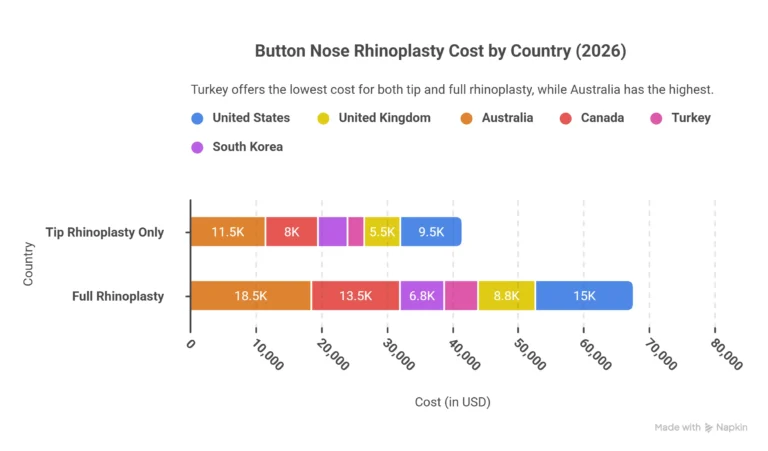
Tip rhinoplasty as a standalone procedure costs less than full rhinoplasty in every market. In the United States, national averages for tip rhinoplasty range from $4,750 to $14,225 depending on surgeon experience, location, and case complexity. This figure covers the surgeon’s fee only. Anesthesia, facility fees, and pre-operative assessments add to the total — bringing most tip rhinoplasty procedures to a total out-of-pocket cost of $6,000 to $16,000 in major US markets. A full international cost breakdown by country is covered in the rhinoplasty cost guide.
Tip rhinoplasty performed under local anesthesia — which is possible in straightforward cases where cartilage grafts from the septum are not required — reduces costs by removing the anesthesiologist’s fee. Not all surgeons offer this option, and not all anatomies are suitable for it. When it is appropriate, it reduces both cost and the systemic risks associated with general anesthesia.
Recovery After Tip Rhinoplasty
Recovery from tip rhinoplasty follows a predictable staged timeline. The first 48 to 72 hours involve peak swelling and bruising around the nose and under the eyes. Keeping the head elevated — including during sleep — reduces swelling during this period. A nasal splint is worn for the first seven days and removed at the post-operative appointment. Most patients return to desk work within seven to ten days.
Tip rhinoplasty recovery is faster than full rhinoplasty in most cases because no bone work is involved. The nasal bones require longer healing than cartilage and soft tissue alone. Strenuous exercise is restricted for four to six weeks. Glasses resting on the bridge of the nose are avoided for the same period. Contact with the nose — including sleeping face-down — is restricted for the first month.
The nasal tip is the last area to fully settle after rhinoplasty. The majority of swelling resolves within two to three months. Subtle tip refinement continues for up to twelve months as tissue adapts to its new structural position. This staged resolution is normal. The tip may look slightly different week to week during the first three months — this is the healing process, not the final result. Full week-by-week recovery detail is covered in the rhinoplasty recovery guide. The complete overview of all surgical options is in the button nose rhinoplasty pillar page.
What to Look for in a Tip Rhinoplasty Surgeon
Tip rhinoplasty is widely described as the most technically demanding component of nasal surgery. The nasal tip involves paired cartilages that behave differently in every patient — varying in strength, flexibility, and response to sutures. Adjustments of a few millimetres at the apex produce visible changes across the entire face. The difference between a result that looks natural at every angle and one that looks operated on is usually in the precision of the cartilage management rather than in the overall surgical plan.
Asking a surgeon specifically about their tip rhinoplasty volume — not just their overall rhinoplasty volume — is the most targeted qualification question. Asking whether they use a preservation-first approach, and how they support cartilage after suture techniques, gives insight into their technical philosophy. Before-and-after images showing tip cases specifically are more informative than general rhinoplasty galleries. A surgeon who explains the anatomy of the lower lateral cartilages and how their planned approach applies to a specific case is demonstrating the level of knowledge that matters most for this procedure.