
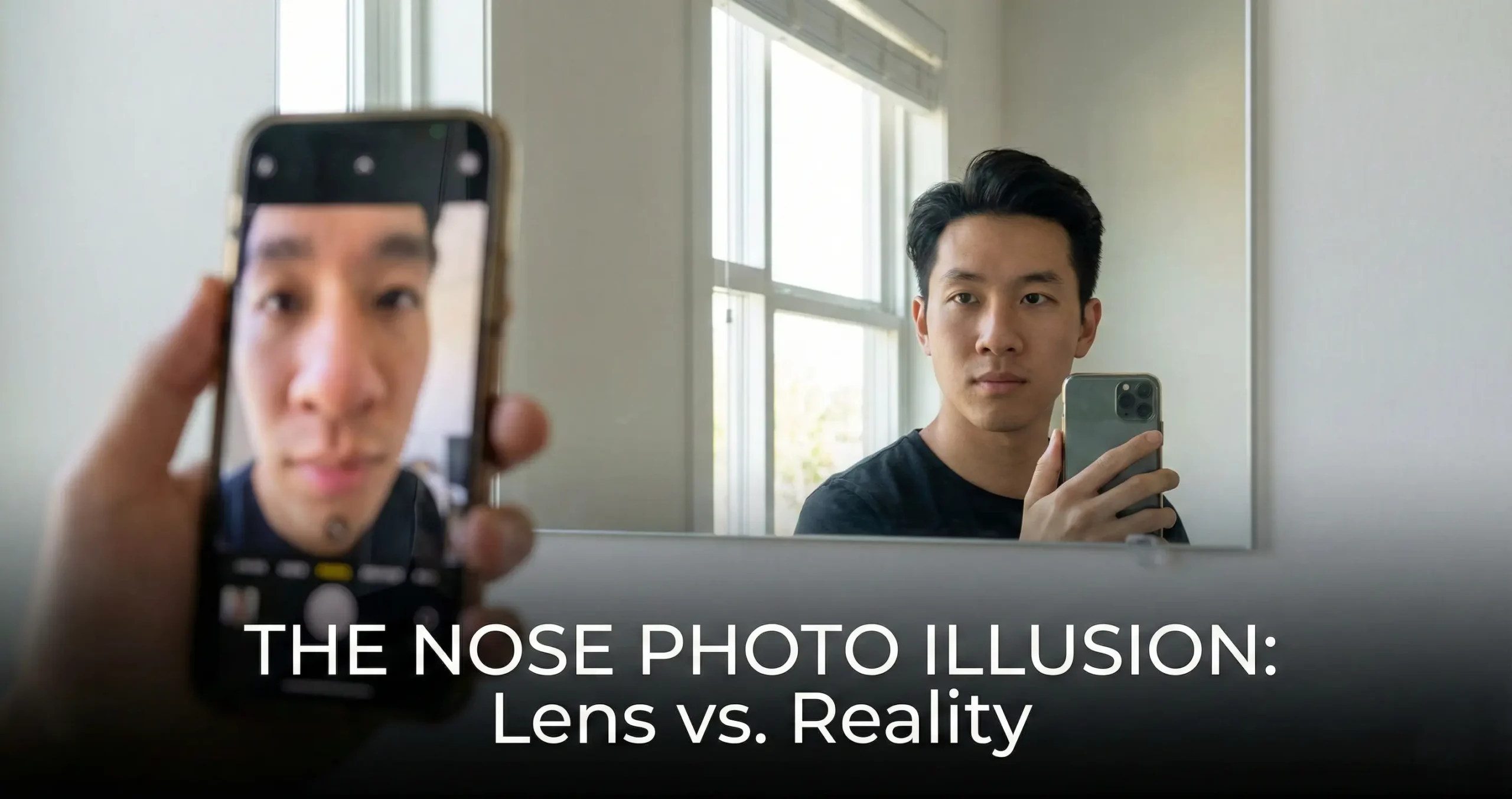
The camera does not see your face the way people do
Front-view photos taken on phones often change how a nose looks. Most phones use wide-angle lenses that are designed to capture more of the scene, not to replicate human vision. These lenses stretch whatever sits closest to them. Since the nose is the most forward feature on the face, it takes the strongest hit from this distortion. The result is a nose that looks wider, rounder, or closer than it does in real life.
Distance plays a quiet role here. When a phone is held at arm’s length, the lens exaggerates depth. In daily life, people rarely see your face from that distance. Conversations happen from farther away, where proportions settle into balance. Mirrors also feel more accurate because they reflect your face at a natural viewing range. This is why a nose that feels fine in the mirror can suddenly look unfamiliar in a front-view photo.
This mismatch creates confusion. The brain trusts the photo because it feels objective, even though it is shaped by lens behavior. Over time, this can plant doubt where none existed before.
Why the front view exaggerates roundness
A nose is not flat. It has structure, angles, and subtle curves that work together in three dimensions. A front-view image compresses that depth into a single plane. When this happens, the nasal tip and soft tissue become the most visible elements, while side contours and bridge transitions lose detail.
This makes many noses appear rounder from the front than they actually are. Roundness here does not mean size. It reflects how light, shadow, and overlap are captured in a still image. Even noses with clear definition from the side can look soft or compact when viewed straight on. This is normal anatomy, not a flaw.
Front-view photos also emphasize symmetry. Any natural variation between the left and right side becomes more noticeable when frozen in a single frame. In motion, these differences blend naturally. In photos, they can feel amplified and personal.
Lighting and posture quietly change everything
Lighting has more influence than most people realize. Overhead lighting casts shadows downward, often widening the appearance of the nasal tip. Indoor lighting, especially from bathrooms or ceiling fixtures, can flatten facial contours. Phone flash creates harsh highlights that erase natural transitions, making the center of the face appear more prominent.
Posture adds another layer. A lowered chin, a slight head tilt, or tension in the face shifts how the nose projects toward the camera. These changes are subtle and often unconscious, yet they strongly affect the final image. A relaxed posture in natural window light can make the same nose look entirely different.
Because these factors are invisible in the final photo, the viewer assumes the image reflects reality. The context that created the distortion disappears, leaving only the impression behind.
Why comparison makes the feeling worse
Photos invite comparison in a way real life does not. Online images are often taken at flattering angles, edited, filtered, or carefully selected from dozens of attempts. When a natural front-view photo is placed next to these images, the difference feels personal and immediate.
The brain does not register the technical differences. It registers contrast. Over time, repeated exposure trains attention toward perceived flaws. This process is automatic. It does not mean someone is vain or insecure by nature. It means the brain is responding to visual patterns.
Front-view nose photos often become the focus because they sit at the center of the face. Once attention locks there, it can be hard to look away. The image starts to feel like evidence rather than a moment shaped by conditions.
Labels add confusion instead of clarity
Many people try to make sense of a photo by assigning a label to their nose. Button, ski slope, straight, rounded. These terms feel helpful at first, but they often create more tension than clarity. Most noses do not fit cleanly into one category, especially when viewed from a single angle.
A nose may appear compact from the side and fuller from the front. That does not make it inconsistent. It reflects how anatomy interacts with perspective. Even professionals avoid strict labels because facial features exist on a spectrum.
When a front-view photo becomes the deciding factor, labels start to feel like judgments. The nose is no longer part of a face. It becomes a problem to solve. This shift is subtle but powerful.
What helps put photos back in perspective
Perspective returns when photos are placed in context. Most people see faces in motion, at conversational distance, and from changing angles. Expressions, posture, and light all soften perception. That is how faces are meant to be seen.
If concern appears only in front-view photos, it usually points to distortion rather than anatomy. This distinction matters. It separates a technical issue from a personal one. Understanding this can ease self-criticism without forcing self-acceptance before someone is ready.
It also helps to remember that no one else studies your face the way you study your own photos. Others see the whole person, not a paused image taken inches away.
When concern deserves attention
There are moments when a nose deserves medical attention, but these are functional, not photographic. Breathing difficulty, pain, or repeated injury are physical issues and should be evaluated by a qualified professional. Appearance concerns that exist only in photos do not signal a health problem.
Separating function from appearance can lower unnecessary worry. It also helps prevent decisions based on images rather than lived experience. Education here is protective, not dismissive.
A calmer way to look at your face
A calmer approach begins by shifting the question. Instead of asking whether a front-view photo looks right, it helps to ask how the face feels in daily life. Faces move. They express emotion. They exist in space, not on screens.
Understanding how cameras alter perception allows room for kindness toward oneself. It does not require loving every photo. It only asks for fairness. Many worries lose strength once the reason behind them becomes clear.A clear, educational explanation of nose shape, perception, and common misconceptions is available here.