
Quick Summary
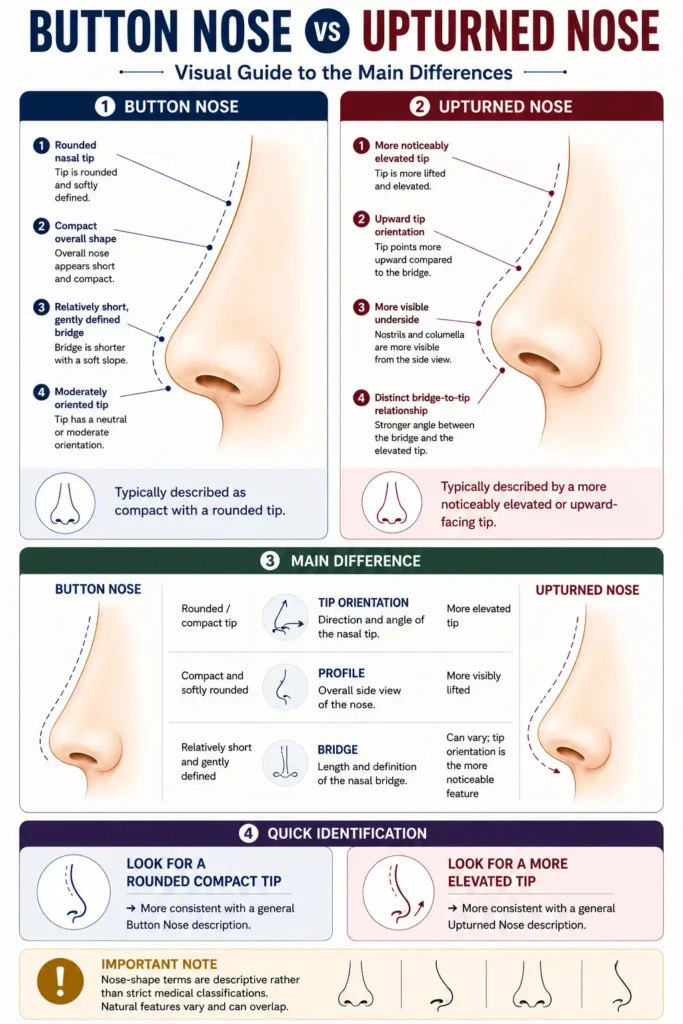
An upturned button nose is a natural variation within the broader button nose shape category. It shares the core traits that define all button nose types — a rounded nasal tip, compact overall length, and smooth bridge line. What distinguishes this variation is a more noticeable upward rotation at the tip. The tip angle sits higher than on a classic button nose, giving the nose a more visibly lifted appearance. This elevated rotation is the defining feature that separates the upturned variation from other button nose types. The upturned button nose is one of the natural shape variations discussed in the button nose types guide.
What Is an Upturned Button Nose
An upturned button nose follows the same structural foundation as other button nose variations. The tip is rounded and sits centrally on the face. The nasal length is compact. The bridge follows a smooth, relatively even line. What changes is the degree of tip rotation. On an upturned button nose, the tip angles more noticeably upward than on a classic variation. This rotation occurs specifically at the nasal tip rather than along the entire nose structure.
It is worth clarifying what upturned means in this context. The rotation happens at the lower portion of the nose where the tip cartilage sits. The bridge and mid-nose may remain relatively smooth and low. The tip then lifts upward at a more pronounced angle from that foundation. This creates a nose that reads as compact and rounded but with a more clearly visible upward tilt at the tip.
The rounded tip keeps this variation firmly within the button nose category. The upward rotation is a degree of difference from the classic variation, not a change in fundamental shape identity. For a full picture of how this and other variations relate to each other, the button nose types guide covers all variations in detail.
Key Structural Traits
The nasal bridge on an upturned button nose typically sits at a low to moderate height. It follows a smooth line from the nasal root toward the tip. The dorsal line does not show significant humps or irregularities in most cases. Some upturned button noses show a very mild concave quality along the bridge before the tip lifts upward. This slight dip reinforces the visual impression of an elevated tip.
Tip rotation angle is the defining structural feature of this variation. The nasolabial angle, which measures the relationship between the upper lip and the base of the nose, typically falls between 115 and 125 degrees on an upturned button nose. This is higher than the 100 to 115 degree range seen on a classic button nose. The increased angle pushes the tip upward and gives the nose its characteristic lifted appearance.
Nostril visibility increases as tip rotation increases. Because the tip points more directly upward, the underside of the nose becomes more visible from a neutral front-facing angle. On an upturned button nose, nostril visibility is more pronounced than on a classic or flat variation. The nostrils appear open and softly rounded rather than hidden or downward-facing.
Nasal base width varies between individuals with this variation. Some upturned button noses are narrow at the base. Others carry a moderate width. Base width and tip rotation are independent traits that can appear in any combination. Overall projection tends to be moderate to low. The upward rotation of the tip can make projection appear reduced because the tip points upward rather than straight ahead.
How It Differs From Other Button Nose Types
The classic button nose carries a gentle upward rotation that falls within a lower nasolabial angle range. The upturned variation increases that rotation noticeably. From the side, a classic button nose shows a soft, even upward curve. An upturned button nose shows a more pronounced lift at the tip. The bridge and mid-nose may look similar between these two types. The difference becomes clearest in the profile view and in the increased nostril visibility from the front.
A wide button nose differs primarily in base width. It carries a broader nostril base and fuller lower nose but does not necessarily show a higher rotation angle. A wide button nose may have a similar tip rotation to a classic variation while simply expressing the shape on a broader lateral scale. Width and rotation are separate structural variables.
A narrow button nose differs in base width in the opposite direction. The slim base and finer bridge of a narrow variation may coexist with any rotation angle, including an upturned one. A nose can be both narrow and upturned at the same time, showing traits from both variation categories simultaneously.
A flat button nose differs in bridge height. The flat variation sits closer to the face plane along the bridge while maintaining a rounded tip. An upturned button nose may also have a low bridge, but the defining feature is the elevated tip rotation rather than the bridge flatness itself. These two variations can overlap in individuals who have both a low bridge and a high rotation angle.
Why Some People Have an Upturned Button Nose
Nose shape develops through inherited biological factors. Genetics determine the underlying bone structure, cartilage positioning, and soft tissue distribution. The degree of tip rotation is governed primarily by the angle and shape of the lower lateral cartilages. When these cartilages are set at a higher upward angle, the tip rotates more noticeably toward the sky. This is a straightforward outcome of inherited cartilage geometry.
The columella, the strip of tissue between the nostrils, also plays a role. A shorter columella relative to the tip can contribute to the appearance of a more upturned shape. The relationship between columellar length and tip position affects how elevated the nose appears in profile.
Nasal bone length influences the overall degree of upward rotation as well. A shorter nasal bone contributes to a more compact nose overall. When that compact structure is combined with angled lower lateral cartilages, the upturned appearance becomes more pronounced. Facial growth patterns during development further shape how all of these features position themselves relative to the surrounding facial skeleton.
The upturned button nose variation appears across many different populations and facial types. It is not associated with any specific ethnic background. It reflects the natural range of lower lateral cartilage angles found across human genetics.
How to Recognize an Upturned Button Nose
Several visual cues help identify this variation. The most consistent indicator is the tip angle. From the side, the tip visibly points upward rather than straight ahead or slightly forward. The profile shows a compact nose with a clear upward lift at the lower end. The bridge leads smoothly to the tip, which then angles upward noticeably.
From the front, the nose appears rounded and compact. Nostril visibility is the key frontal indicator. Because the tip rotates upward, the nostrils are partially visible even when looking straight at the face from a neutral angle. The nostrils appear soft and open rather than hidden beneath the tip.
The overall nose reads as small and lifted. The rounded tip dominates the lower portion of the nose in the front view. The bridge does not draw significant attention. The upward tilt gives the nose a distinctive character that is easy to identify once the rotation angle is understood.
Many people show mixed traits across nose variations. A nose may carry the upturned rotation of this variation alongside the narrow base of another type or the flat bridge of a different variation. These combinations are common and normal. Nose shape classification works best as a general reference framework. The types of noses overview provides helpful broader context for understanding how all nose shapes relate and overlap.
Natural Variation in Nose Shapes
Nose shapes exist on a continuous spectrum. Tip rotation angle, bridge height, base width, projection, and overall length combine differently in every individual. No two noses are structurally identical, even within the same variation category.
The upturned button nose sits within a category defined by consistent core traits, but the degree of upward rotation varies between individuals. Some people show a mildly elevated tip that barely exceeds the classic rotation range. Others show a more pronounced upward tilt that is immediately visible in profile. Both fall within the same general classification.
At the more extreme end of the upturned range, the nose may begin to share traits with the snub nose, which is a structurally distinct shape category rather than a button nose subtype. The boundary between a strongly upturned button nose and a mild snub nose can be subtle. Understanding where one category ends and another begins requires looking at the full combination of traits rather than tip rotation alone.
Key Takeaway
An upturned button nose is one natural variation within the full range of button nose types. Its core features are a rounded tip, compact nasal length, smooth bridge line, and a more noticeably elevated tip rotation. The increased rotation angle modifies the profile appearance and increases nostril visibility without changing the fundamental structural identity of the shape.
This variation appears through inherited differences in lower lateral cartilage angle, columellar length, and nasal bone structure. It is a normal anatomical pattern found across all backgrounds and facial types. Like all nose shapes, it represents one point on a wide and naturally occurring spectrum of human variation.