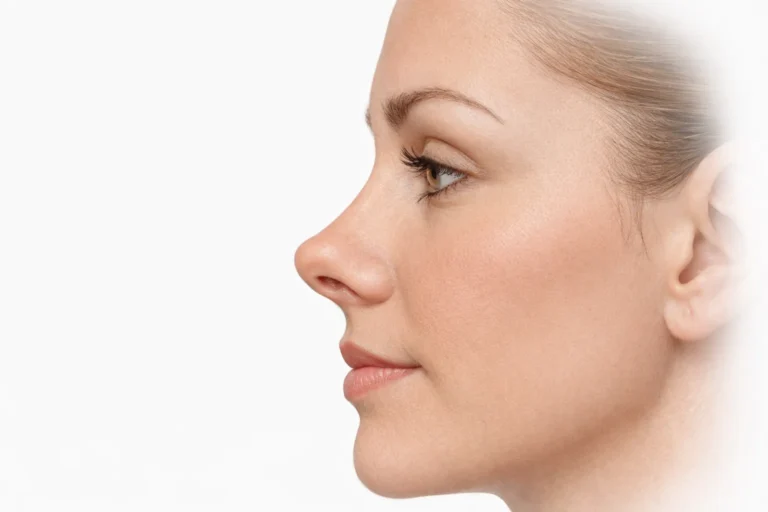
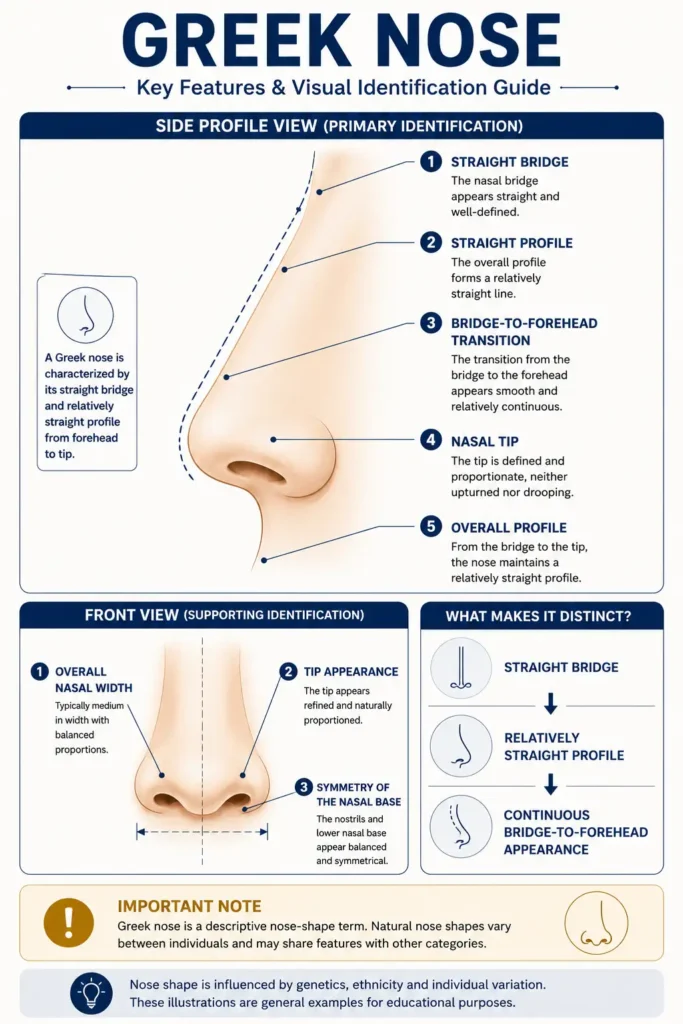
A Greek nose has a straight, continuous bridge that runs from the forehead to the tip with no bump, dip, or curve. The forehead and nose form nearly one unbroken line, a proportion sometimes called the “Greek profile.” It’s one of the more balanced-looking nose shapes, but it isn’t rare, and it isn’t a fixed medical category — it’s a descriptive term for a profile pattern.
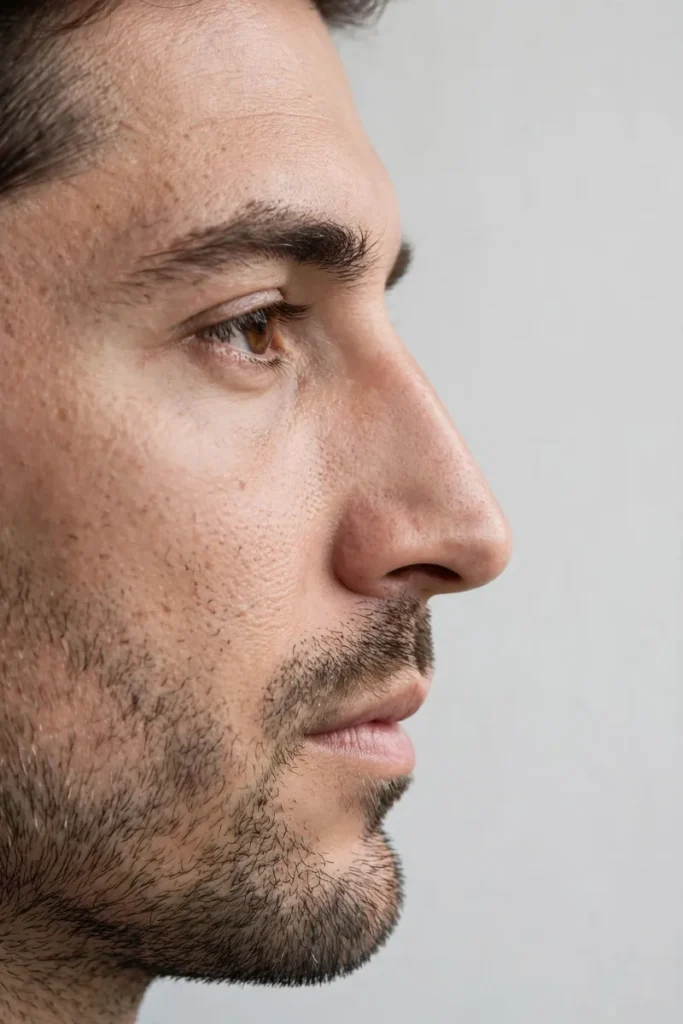
What Defines a Greek Nose Shape
The defining trait is the nasofrontal angle: the point between the eyes where the forehead meets the bridge of the nose. On a Greek nose, that angle barely breaks — the line stays flat instead of stepping down or up.
The tip sits in line with the bridge rather than curving upward like a button nose or hooking downward like a Roman nose. That alignment is what keeps the profile reading as one continuous plane from brow to tip.
Bridge width varies from person to person and doesn’t change the classification. A Greek nose can be narrow or moderately wide; what matters is the straightness of the line, not how much space it takes up on the face.
Nostril shape typically follows the same proportional pattern — oval and evenly matched — but this is a secondary trait. Two people can share the same straight bridge and still have noticeably different nostril shapes.

Where the Name Comes From
The term traces back to classical Greek sculpture, where sculptors idealized this straight forehead-to-nose-tip line as a proportion standard. Statues like the Venus de Milo and Apollo Belvedere show the pattern clearly: the brow and nose read as one continuous plane when viewed from the side.
Renaissance artists carried the same proportion forward into portraiture and anatomical studies of the face, treating it as a benchmark for classical facial balance rather than a new invention. That’s part of why the label has stuck for centuries instead of fading with the era that coined it.
The name describes a visual pattern, not ancestry. Having a Greek nose doesn’t indicate Greek heritage, and the shape appears across populations worldwide — the term is a reference to sculpture and art history, not a claim about genetics or ethnicity.
Common Misconceptions
A Greek nose isn’t the same as a large nose. Bridge length and overall nose size vary independently of the straight-line trait, so this shape can appear on a small nose or a larger one — straightness is the defining feature, not scale.
A Greek nose isn’t fixed from birth. Nasal cartilage keeps developing through adolescence, so a child’s profile can still shift into early adulthood. A nose that looks straight at age ten isn’t guaranteed to look identical at twenty.
A Greek nose isn’t a sign of any particular ancestry. As above, this is worth repeating because it’s the most common misunderstanding attached to the term — it’s an aesthetic classification, not a genetic one.
How to Tell If You Have One
Take a photo of your side profile with your head level and your hair off your face, in even lighting that doesn’t cast a shadow along the bridge. Uneven lighting is the most common reason people misjudge their own profile from a photo.
Trace an imaginary line — or hold a straight edge like a ruler up to the screen — from the middle of your forehead down to the tip of your nose. If that line stays essentially straight, with no visible step-down at the bridge and no upward or downward hook at the tip, you likely have a Greek nose.
Check more than one angle if the first photo is inconclusive. A slight head tilt can make a straight bridge look broken, or a broken bridge look straight, so a second photo from a slightly different angle is worth taking before drawing a conclusion.
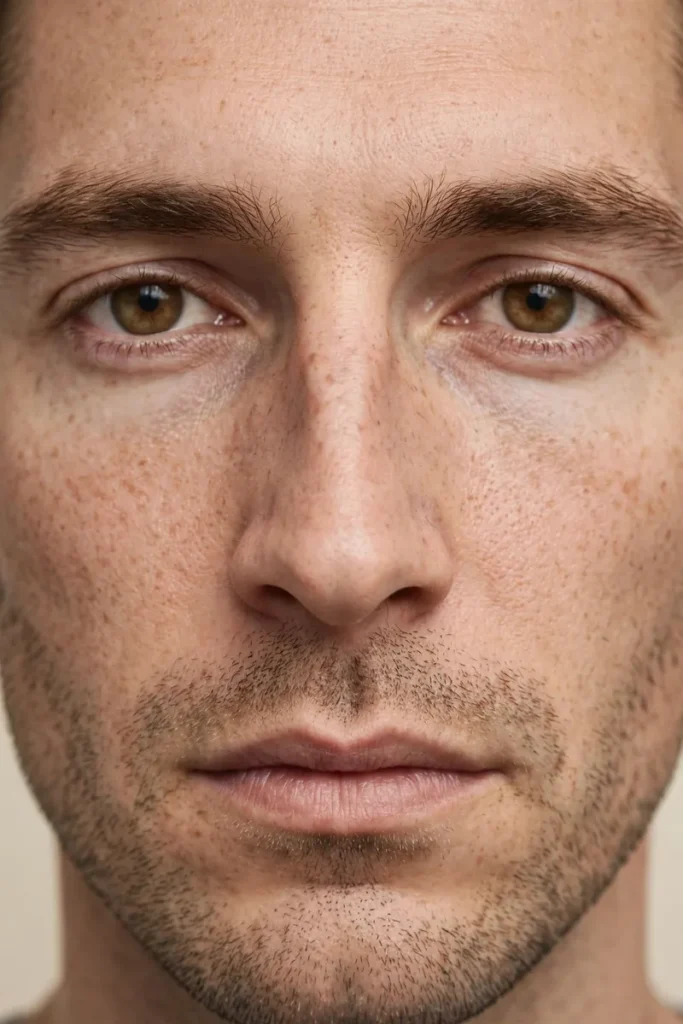
A front-facing photo won’t show this trait at all. The defining feature is only visible from the side, so front-facing selfies — even good ones — aren’t useful for this specific check.
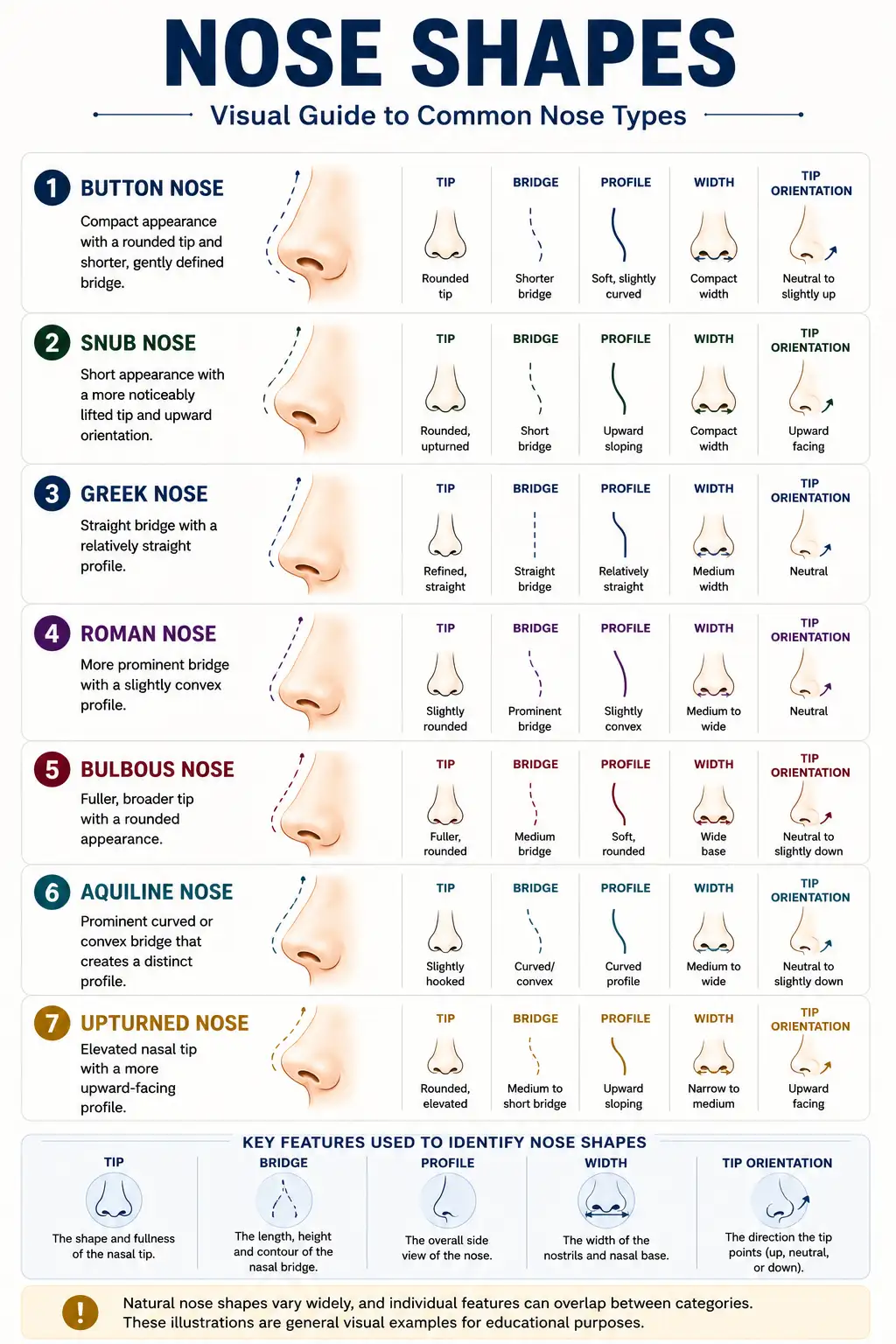
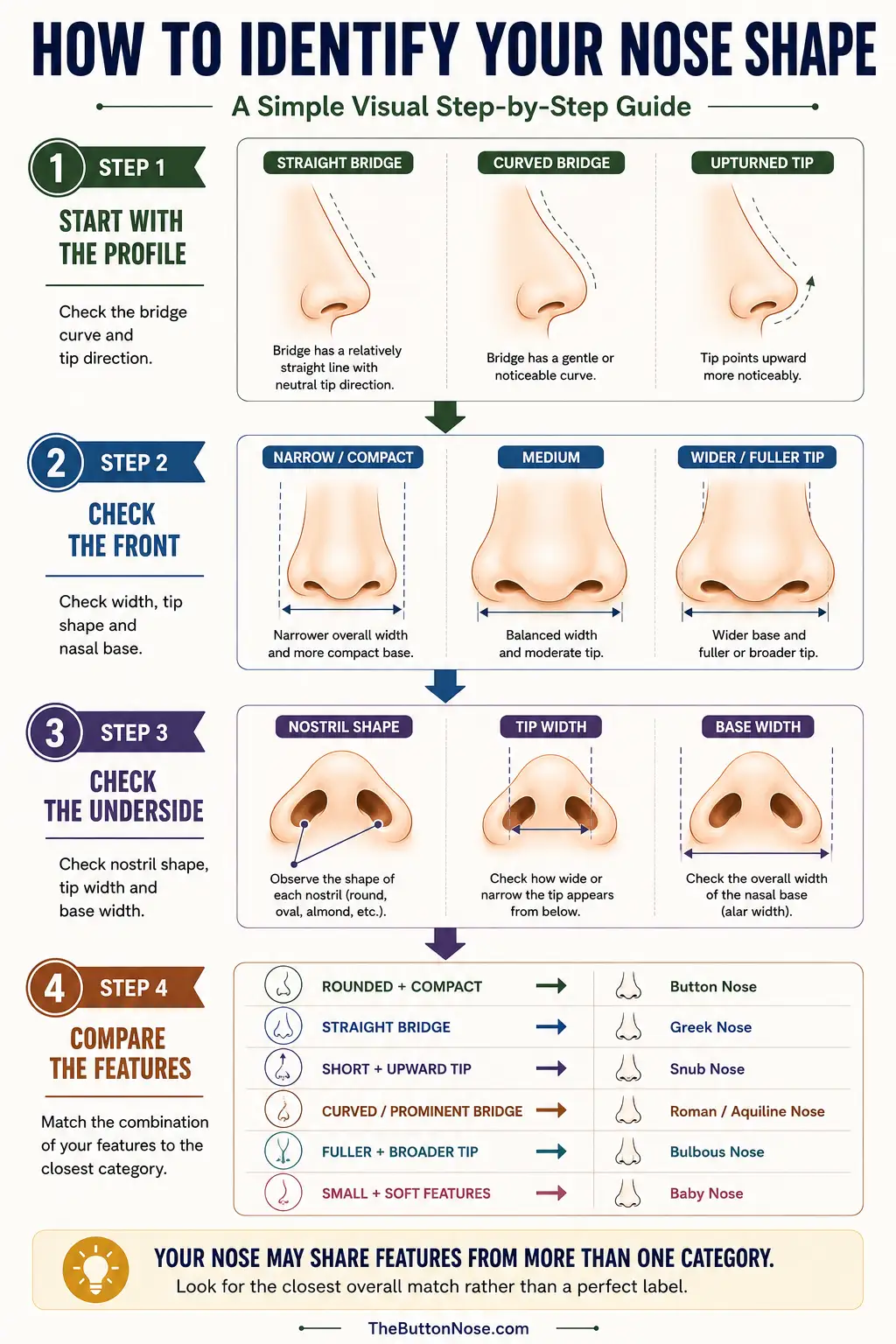
Greek Nose vs. Other Nose Shapes
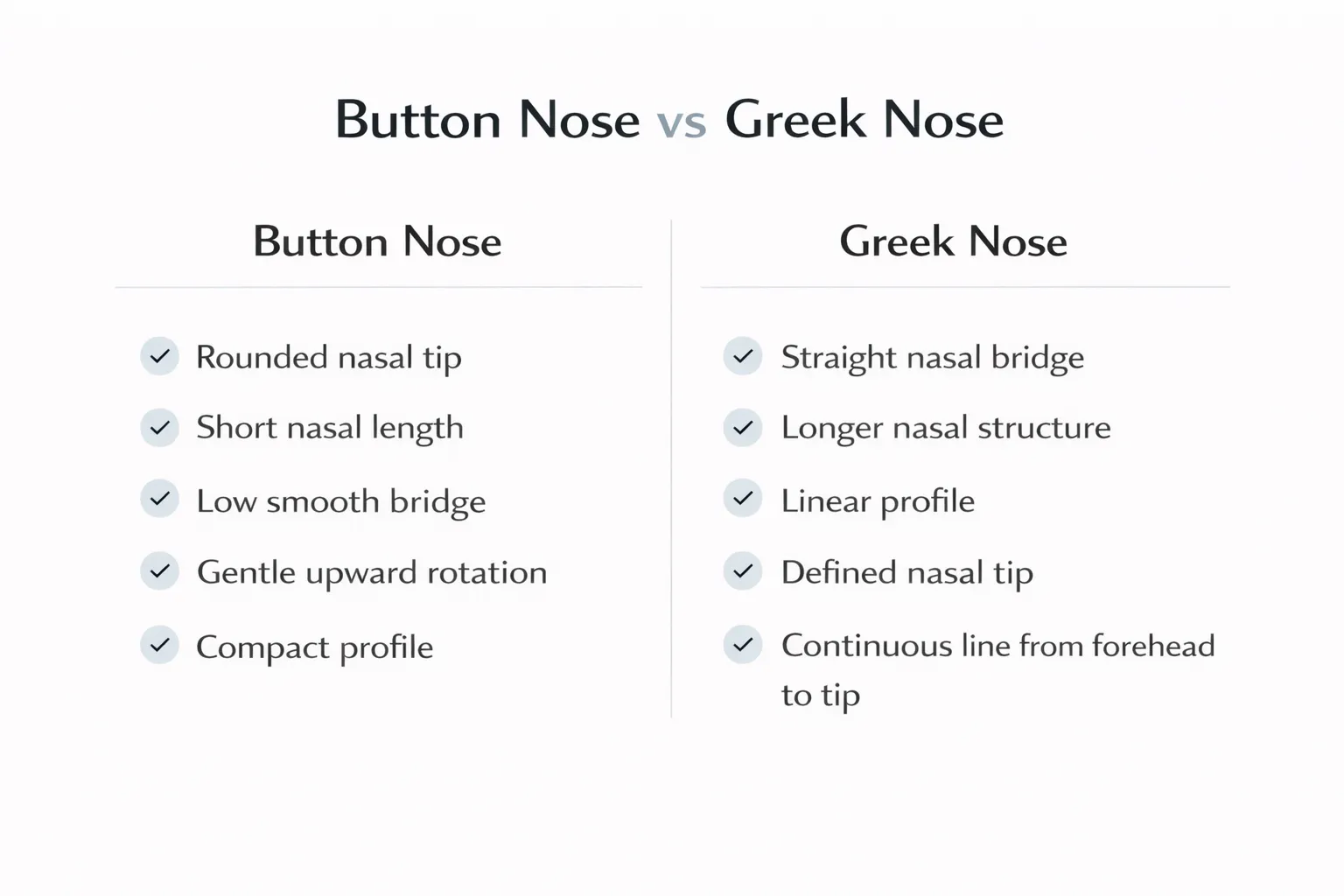
A button nose has a shorter bridge and a tip that turns upward, which breaks the straight line a Greek nose keeps intact. The two are the shapes people mix up most often, since both can look neat and proportionate in photos, but the profile view separates them clearly.
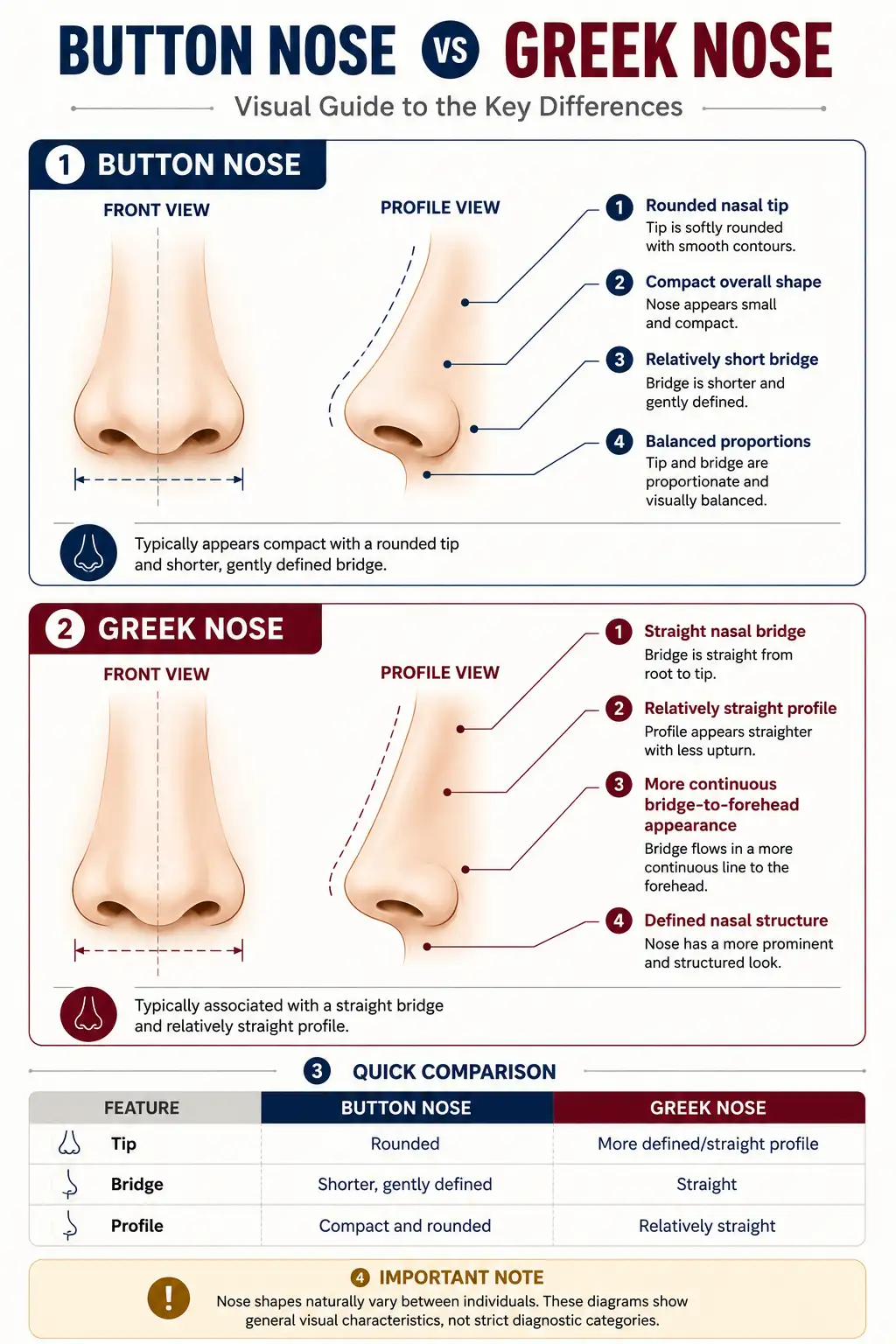
A Roman nose curves outward partway down the bridge, giving it a slight hook instead of staying flat. This is the opposite adjustment from a button nose — the line breaks outward rather than upward — but it’s still a break, which is what distinguishes it from a Greek nose.


A snub nose is shorter overall, with a flatter, less defined bridge and a tip that tilts upward more noticeably than a button nose. Where a Greek nose is defined by length and straightness, a snub nose is defined by shortness.

For a full breakdown of the two shapes people confuse most, see our button nose vs. Greek nose comparison. For a side-by-side look at every common profile in one place, the full nose shape overview covers all of them together.

Is a Greek Nose Considered Rare or a Beauty Standard?
It isn’t rare — it’s one of the more commonly described profile types, not a genetic outlier. It’s frequently referenced as an aesthetic ideal in art history and modern beauty commentary, but that reputation reflects a cultural preference, not an objective measure of attractiveness.
Beauty standards tied to nose shape have shifted across eras and regions. Some periods and cultures have favored a stronger, more defined bridge; others have favored the softer, upturned look of a button or snub nose. No single shape has held a permanent claim on being considered ideal.
FAQ
What makes a nose a “Greek nose”?
A straight, unbroken line from the forehead to the nose tip, with no visible step at the bridge and no upward or downward curve at the tip. It’s identified from a side profile, not a front-facing view.
Is a Greek nose the same as a Roman nose?
No. A Roman nose has a slight outward curve or hook partway down the bridge, while a Greek nose stays flat the entire length. They’re often confused because both read as “straight-ish” in casual conversation, but the profile lines are different.
Is a Greek nose the same as an aquiline nose?
No. “Aquiline” specifically describes a curved, beak-like bridge, which is closer to a Roman nose than a Greek one. A Greek nose has no curve at all — that’s the trait that separates it from both.
How rare is a Greek nose?
It isn’t statistically rare. It’s a commonly occurring profile pattern, and its association with classical sculpture has made it a recognizable reference point rather than an unusual one.
Can I identify a Greek nose from a front-facing photo?
Not reliably. The defining trait is the bridge line viewed from the side, so a front-facing photo won’t show whether the forehead and nose form a continuous plane.
Does a Greek nose change with age?
Cartilage and skin continue to shift subtly throughout adulthood, and more noticeably during the teenage years. The core bridge-to-tip line typically stays recognizable even as minor changes occur.
Is a Greek nose considered attractive?
It’s frequently cited as an aesthetic reference point in art and beauty commentary, but attractiveness is subjective and varies by culture and individual preference. No single nose shape is universally rated as more attractive than others.