
What Nose Shape Do I Have?
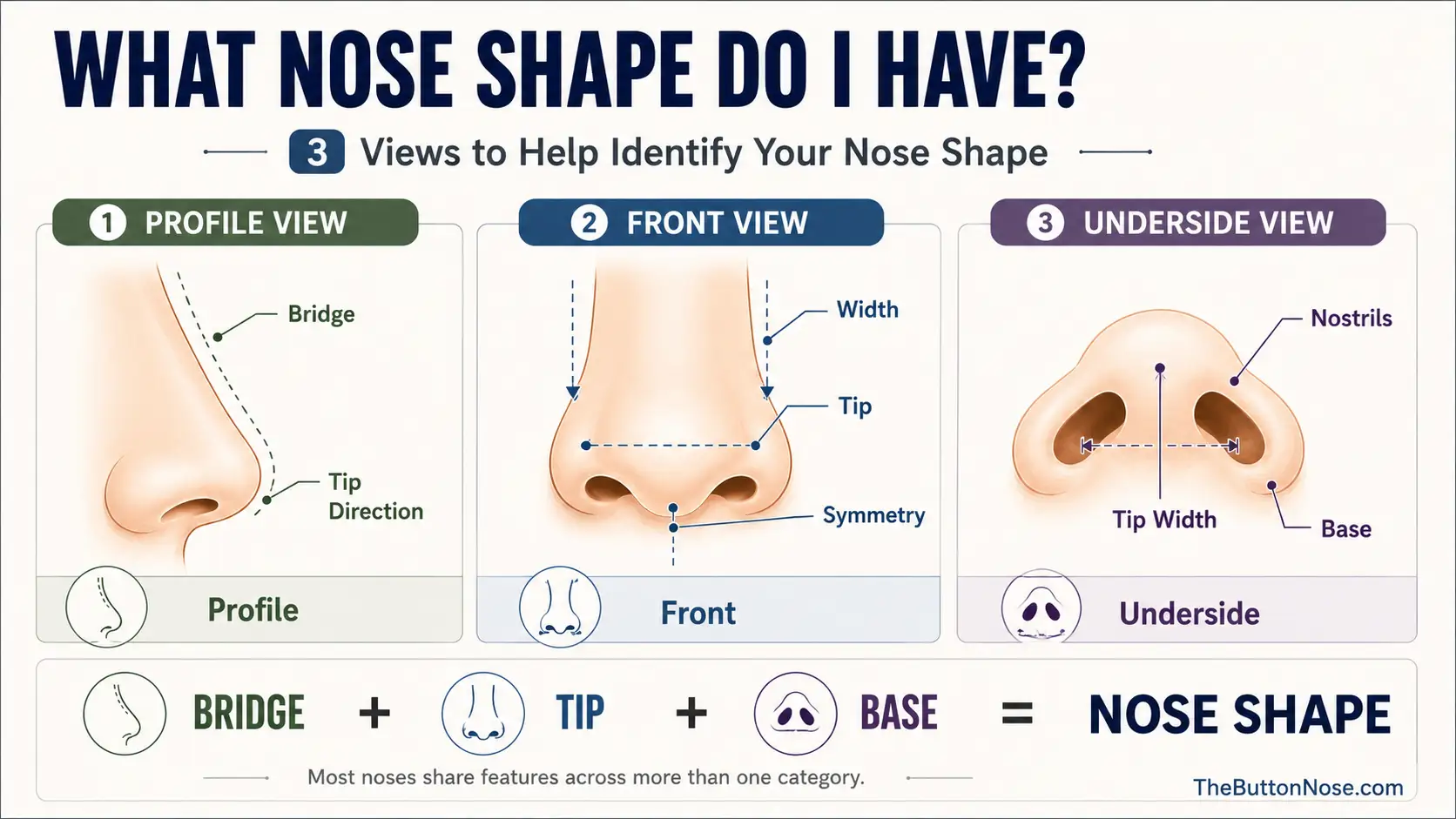
You can identify your nose shape by looking at three angles: the profile for bridge curve and tip direction, the front view for width and symmetry, and the underside for tip and nostril shape. Most nose shape categories are named for these same three features — bridge, tip, and base — which is why a single nose can share traits across more than one category. There is no test that assigns a single correct label; the goal is finding the closest match, not a perfect one.
Why Nose Shapes Are Hard to Self-Diagnose
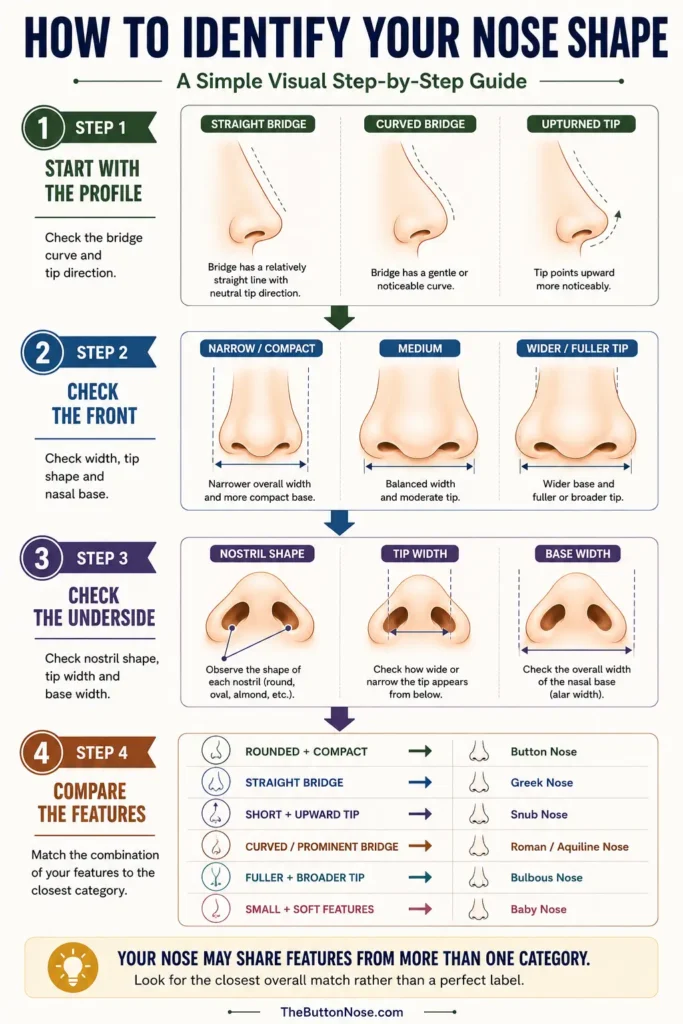
Nose shape categories describe common patterns, not fixed types. A nose with a straight bridge and a slightly rounded tip might read as a greek nose from one angle and lean toward a button nose from another. Genetics, camera angle, and lighting all affect how a nose appears in a photo, which is part of why online quizzes and single-photo tools often give inconsistent results. Working through each view separately, rather than relying on one photo, gets you a more reliable answer.
How to Check the Profile View
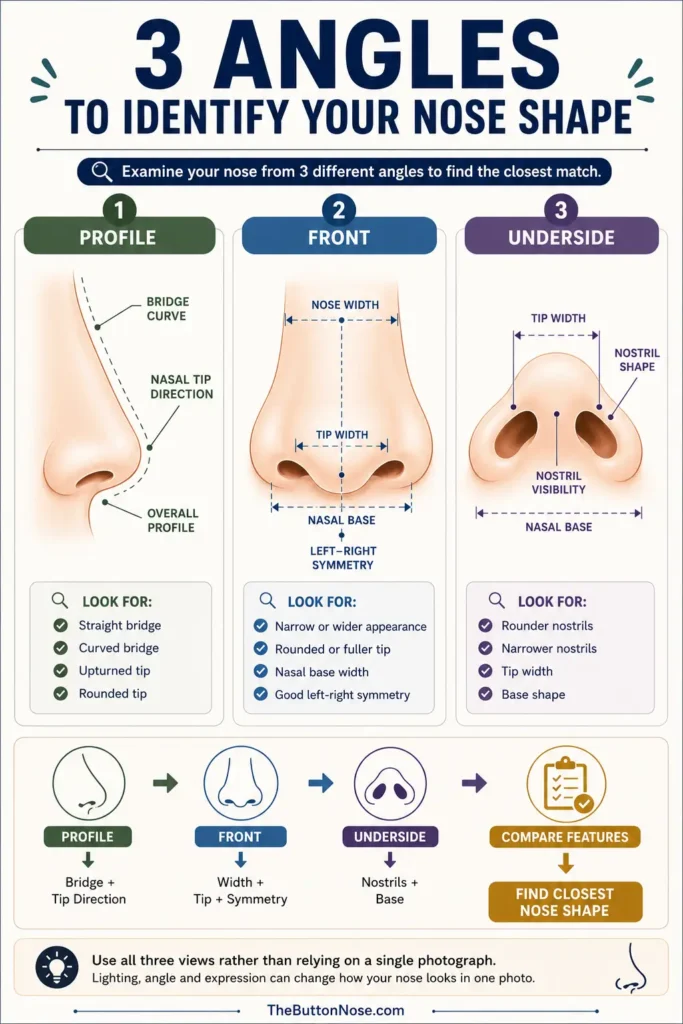
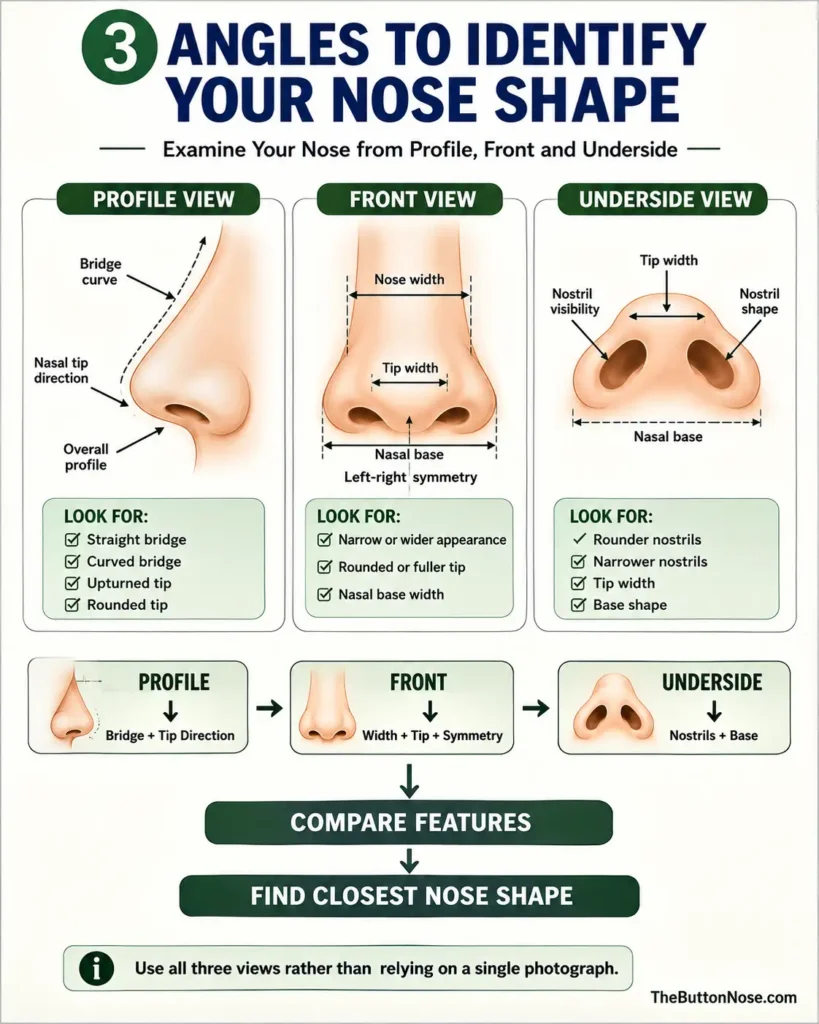
Stand sideways to a mirror or camera and look at the line from your forehead to your nasal tip. A straight line with no bump usually points toward a greek nose. A raised curve partway down the bridge is closer to a roman or aquiline shape, covered in our button nose vs. roman nose comparison. A tip that lifts upward at the end, rather than pointing straight out, is the defining trait of a snub nose or a more stylized version sometimes called a barbie nose.
How to Check the Front View
Facing forward, look at width relative to the rest of your face and whether the two sides match. A narrower nose with a rounded, compact tip is typical of a button nose. A wider base with fuller nostrils is more characteristic of a bulbous or nubian shape, detailed in our button nose vs. bulbous nose comparison. Symmetry matters here too — most people have some natural asymmetry between the left and right side, which is normal and not a sign of any underlying issue on its own.
How to Check the Underside View
Tilt your chin up and look at your nose from below. This angle shows nostril shape and tip width most clearly, two features that are hard to judge from the front or side alone. Rounder, more visible nostrils often pair with an upturned or button shape. Narrower, less visible nostrils typically pair with a straighter bridge, like a greek or roman nose.
Common Nose Shape Categories
Most nose shapes fall into a handful of recognizable categories, each shaped by the same three variables: bridge curve, tip direction, and base width.
A button nose is small, rounded, and slightly upturned, with a compact tip. A greek nose is straight along the bridge with minimal curve, often called the most symmetrical shape. A snub nose is short with a tip that turns upward more noticeably than a button nose. A roman nose, also called aquiline, has a raised curve partway down the bridge. A bulbous nose has a rounder, fuller tip relative to the rest of the nose. A baby nose is small and soft-featured, a term often used interchangeably with button nose though the two aren’t identical, explained in our button nose vs. baby nose comparison.
A full breakdown of every recognized category, with side-by-side visual traits, is on our complete guide to nose types.
If You’re Considering Changing Your Nose Shape
Some readers use shape identification as a first step before exploring rhinoplasty, not as an end in itself. Primary rhinoplasty costs $9,000 to $20,000 nationally, with an average surgeon’s fee near $7,637, according to the American Society of Plastic Surgeons. That figure varies by technique, complexity, and which structural changes a specific shape requires, so treat it as a planning range rather than a quote. Our button nose rhinoplasty guide covers what the procedure involves once you’ve identified the shape you’re starting from.
What to Check Before Trusting Any Source on Nose Shape
Look for board certification through the American Board of Plastic Surgery or the American Board of Facial Plastic and Reconstructive Surgery before taking surgical advice from any source, online quiz results included. Shape identification alone doesn’t determine what changes are realistic for your anatomy — that assessment requires an in-person consultation with a credentialed surgeon.
FAQ
Is there an official test for nose shape?
No single test exists. Surgeons typically assess bridge curve, tip direction, and base width from three angles during a consultation, which is the same method used in this guide.
Can my nose shape change over time?
Yes. Cartilage and skin continue to shift gradually with age, and injury or previous surgery can also change bridge or tip shape. A nose shape identified today may look slightly different a decade from now.
Why do online nose shape quizzes give different results?
Most rely on a single photo, and angle, lighting, and expression all affect how a nose appears. Checking your profile, front, and underside separately, as outlined above, gives a more consistent answer than one photo alone.
Does nose shape depend on ethnicity?
Genetics and ancestry influence common patterns in bridge height and base width across populations, but individual variation within any group is significant. No nose shape is exclusive to one ethnicity.
What’s the difference between a button nose and a baby nose?
The terms are often used interchangeably, though a baby nose typically refers more broadly to a soft, small-featured nose, while button nose specifically describes a rounded, upturned tip. Our button nose vs. baby nose page breaks down the distinction in detail.