
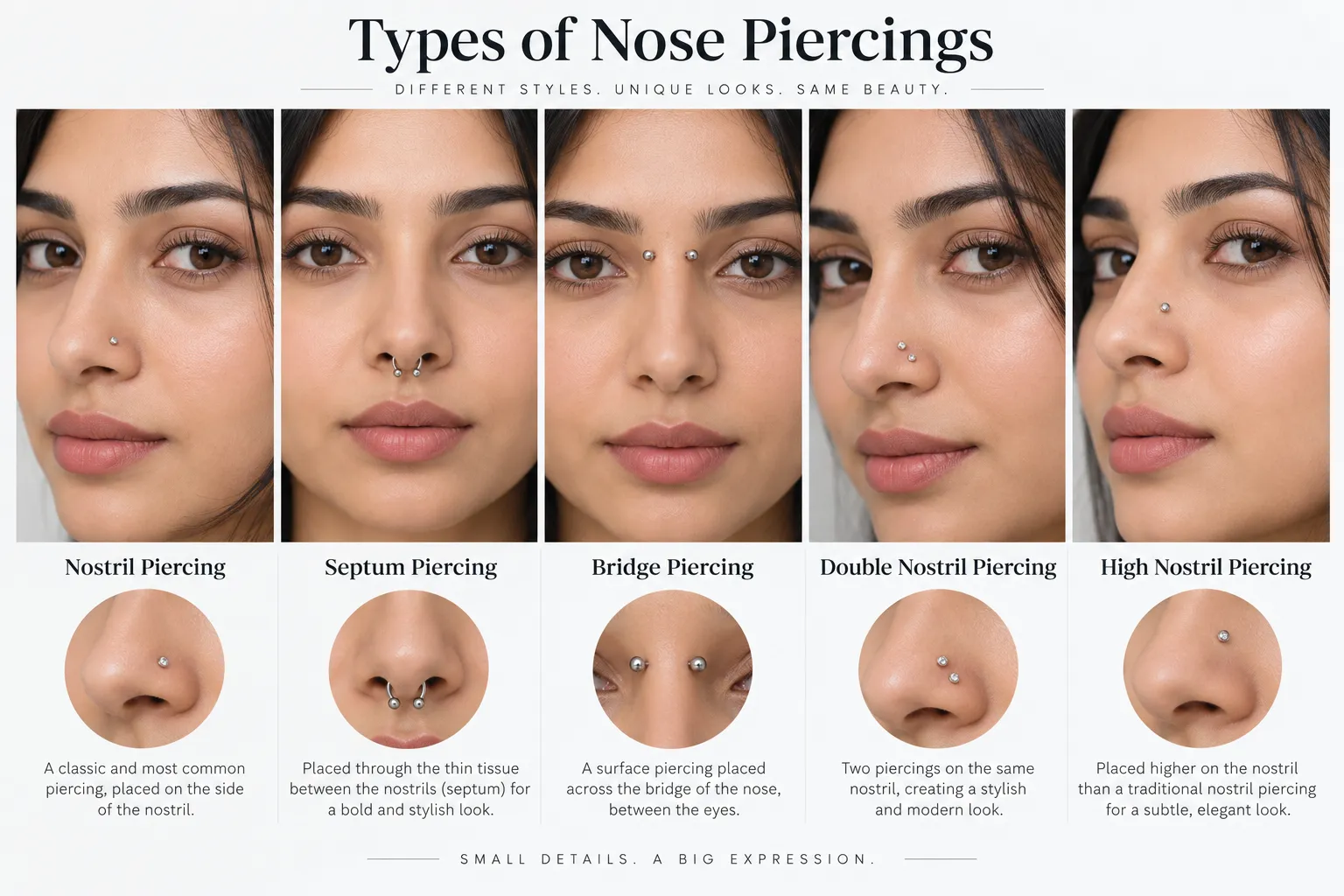
A nose piercing is a small hole through the nostril, septum, or bridge that holds jewelry, and it usually costs about fifty to one hundred dollars with basic jewelry. WebMD and Greatist put nostril healing at two to six months, and price guides from Fash and Bustle back up the cost range. Placement, jewelry, and aftercare can shift both numbers. Nostril piercings are the most common type of nose piercing. Bustle calls the classic nostril stud the most popular choice. Septum, bridge, and double piercings are the other main options.
The Main Piercing Types and Where They Sit
Nostril piercing
A nostril piercing goes through the side of the nostril, near the crease where it meets the cheek. Fash reports that this is the most common type. WebMD lists two to four months of healing, and Greatist lists four to six. It usually holds a small stud or hoop.
Our guide to nostril studs covers styles and sizing. Not ready for the needle? Our fake nose piercing guide covers magnetic and clip-on options that give you the look without the commitment.
Septum piercing
A septum piercing goes through the thin tissue between the two nostrils. WebMD lists about one and a half to two months of healing, and Greatist lists two to three.
Our septum piercing guide covers jewelry options.
Bridge piercing
A bridge piercing runs across the top of the nose, between the eyes. WebMD gives two to two and a half months for healing, and Greatist gives two to three.
Our bridge piercing guide lists what to ask a piercer.
Double, high nostril, and rarer types
A double nose piercing adds a second hole on the same side or the opposite side. A high nostril piercing sits higher on the nose, and Fash notes that many shops charge more for it because the placement is harder.
A nasallang runs one bar through both nostrils and the septum. Greatist lists four to six months of healing for a nasallang and six to nine for a vertical tip piercing.
Our types guide and double piercing guide cover the rest.
What Happens During the Appointment
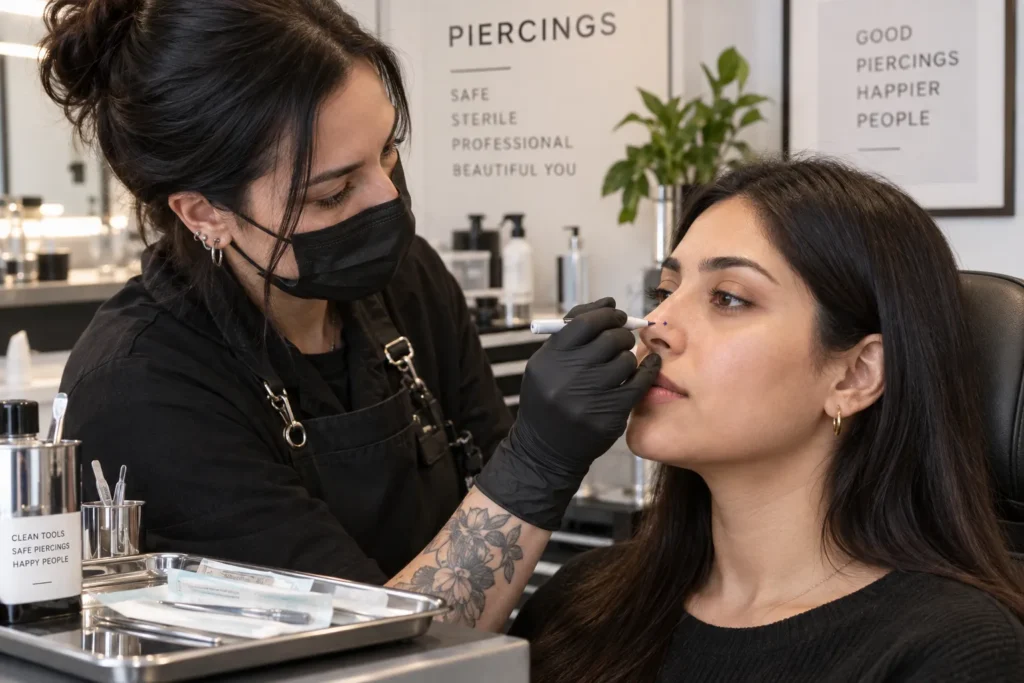
A standard appointment follows a set order. The piercer checks your anatomy, marks the spot, cleans the skin, and pierces with a single-use hollow needle. Then they fit the jewelry and hand you aftercare steps.
Ask each studio to walk you through its routine before you book.
A needle is the right tool, and a piercing gun is not. WebMD says guns cannot be properly sterilized. Greatist says guns cause more tissue trauma than needles.
Put the appointment off if you have a sinus or respiratory infection. WebMD advises waiting until you have recovered.
How Long Does a Nose Piercing Take to Heal?
Published healing times for a nostril piercing run from two to six months. WebMD lists two to four months. Greatist lists four to six. Cleveland Clinic says a piercing can take up to six months to heal fully.
Plan for the longer end.
The first days bring mild pain, redness, and clear fluid that dries into a crust. Cleveland Clinic says these symptoms should ease within a few days with proper care.
WebMD adds that the skin builds a protective layer around the hole during weeks two through four.
Jewelry affects the timeline. Greatist says thicker jewelry takes longer to heal.
Keep the starter jewelry in until the piercing has healed. Cleveland Clinic says removing or swapping jewelry early can get in the way of healing. Greatist warns that taking jewelry out of an irritated piercing can close the hole and trap bacteria inside.
Our healing time guide gives the stage-by-stage view, and when to change your jewelry covers the first swap.
Aftercare: How to Clean and Protect the Piercing
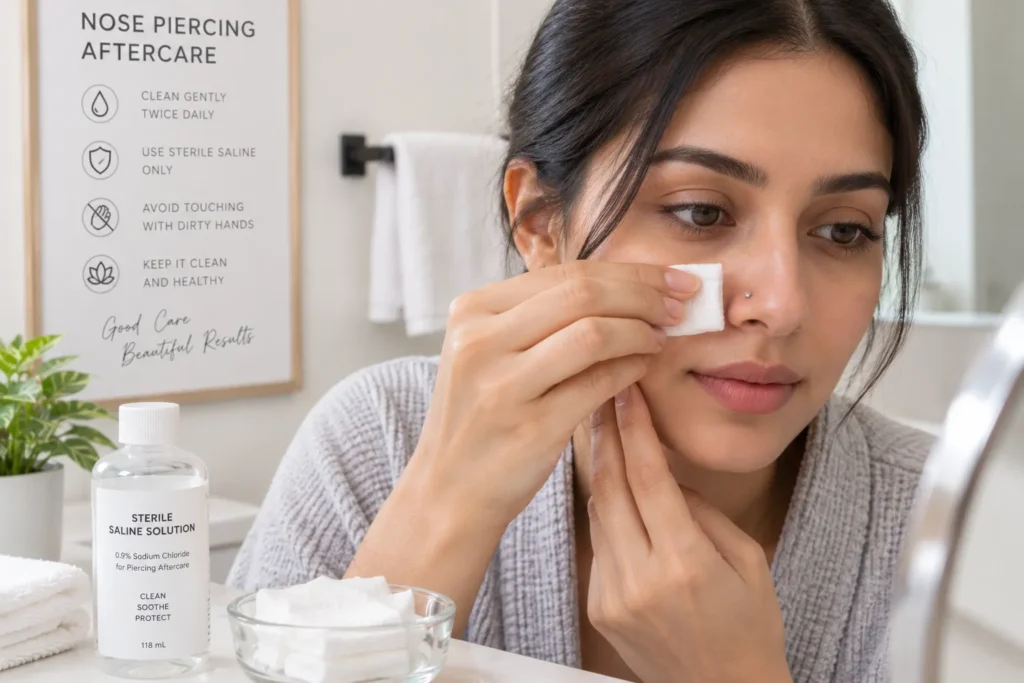
Sterile saline is the standard cleaner. Greatist advises cleaning both sides of the piercing with it three times a day.
It also warns against hydrogen peroxide, alcohol, and antibiotic ointments, which can irritate the skin and slow healing.
If you think the piercing is infected, ask a doctor what to apply.
Clean hands and clean fabric protect the hole. WebMD says to wash your hands before touching the piercing and to change sheets and towels weekly until it heals.
Cleveland Clinic says not to pick at crust, bumps, or discharge.
Our aftercare guide covers the full routine.
Jewelry: Which Metals Are Safe for a New Piercing
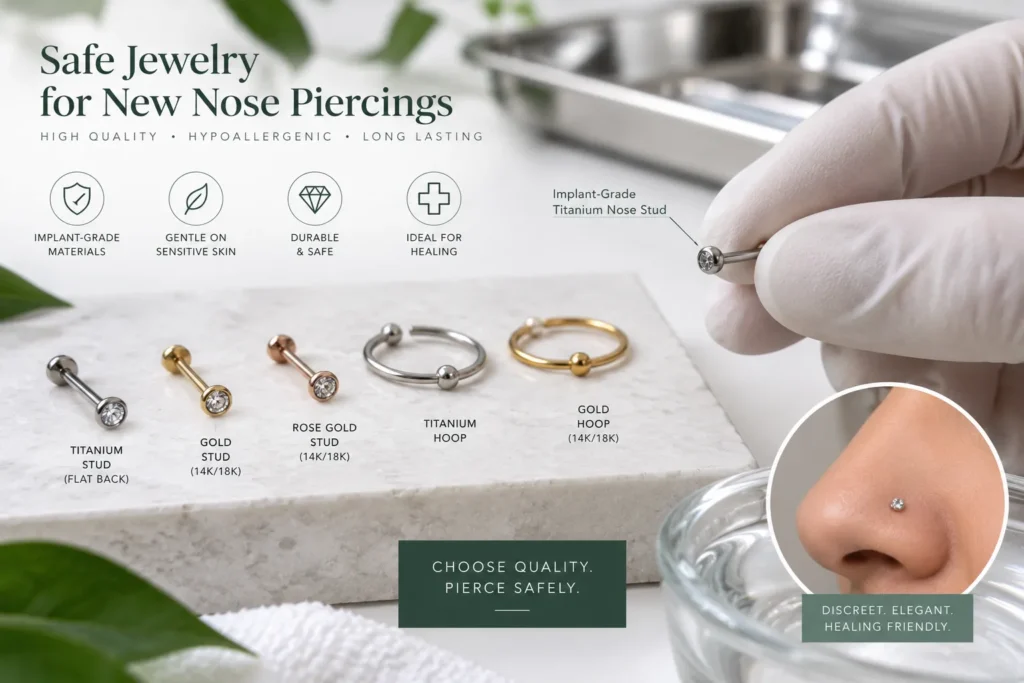
The Association of Professional Piercers (APP) recommends implant-certified titanium for new piercings. It points to titanium that meets ASTM F-136 or other listed standards.
It also names niobium as a metal piercers have used with good results.
The label “surgical steel” does not prove a piece is safe. The APP says only certain steel grades are proven biocompatible, such as steel that meets ASTM F-138.
Ask the studio for the exact standard.
A metal allergy can mimic an infection. Cleveland Clinic says a provider can tell the two apart, and switching to a higher-quality metal fixes an allergy.
Our jewelry guide and gauge size guide cover materials and sizing.
If your jewelry ever comes out, our guide to a fallen-out nose stud explains what to do.
Our stuck jewelry guide shows how to remove a nose ring that won’t budge — safely.
Common Problems and When to See a Doctor
Piercing problems are common. Cleveland Clinic reports that nearly one in four people with body piercings, not counting earlobes, have had an infection or another medical issue. The same source says most infections in the nose are minor.
An infected piercing looks and feels different from normal healing.
Cleveland Clinic lists swelling, pain, redness, warmth, and thick yellow pus as signs. WebMD says to call a doctor if you notice signs of infection, and it treats a fever as a warning you should not ignore.
Irritation bumps are a common reaction. Bustle’s guide, which draws on a board-certified dermatologist, links them to snagged jewelry, overcleaning, fiddling with the jewelry, and low-quality metal.
Keloids differ from irritation bumps. Medical News Today explains that piercing bumps tend to appear quickly and stop growing, while keloids form slowly, keep growing, and do not go away without treatment.
See a doctor or dermatologist if you suspect one.
Our guides on piercing problems, bumps, infection, and keloids go deeper.
Our scars guide explains what marks to expect and how to minimize them.
Piercing Cost: What You Pay in the United States
A standard nostril piercing with basic jewelry costs about $50 to $75, according to Fash.
Fash puts high nostril piercings at $60 to $100 and says complex types, such as the nasallang, can pass $100.
Many studios price the fee and the jewelry separately.
Bustle quotes $30 to $60 for the piercing itself, basic implant-grade jewelry from about $40, and $500 or more for gold and gemstone pieces.
Studio, piercer experience, and placement difficulty all move the total.
Bustle says prices trend higher with a more experienced piercer, a more prestigious studio, or a complicated style.
Treat $50 to $100 as a planning range, not a fixed quote.
Compare studios on safety standards first and price second.
Our cost guide breaks down what a quote should include.
How to Choose a Piercer
Training and studio rules vary by location. The APP says you cannot assume basic safety standards apply in your area, so you need to check the studio yourself.
APP members follow the group’s published standards. The APP says your piercer should meet those standards even without membership.
You can search its member locator by city at safepiercing.org.
A safe studio uses sterile, single-use equipment.
WebMD says a trained piercer uses a sterile needle, disinfects tools in an autoclave, and asks about your health and possible pregnancy.
Experience matters for placement and for nerves.
Greatist says an inexperienced piercer, especially one using a gun, can hit a nerve, and nerve damage can cause lasting numbness.
Our guide to choosing a piercer lists questions to ask.
Nose Shape and Piercing Placement
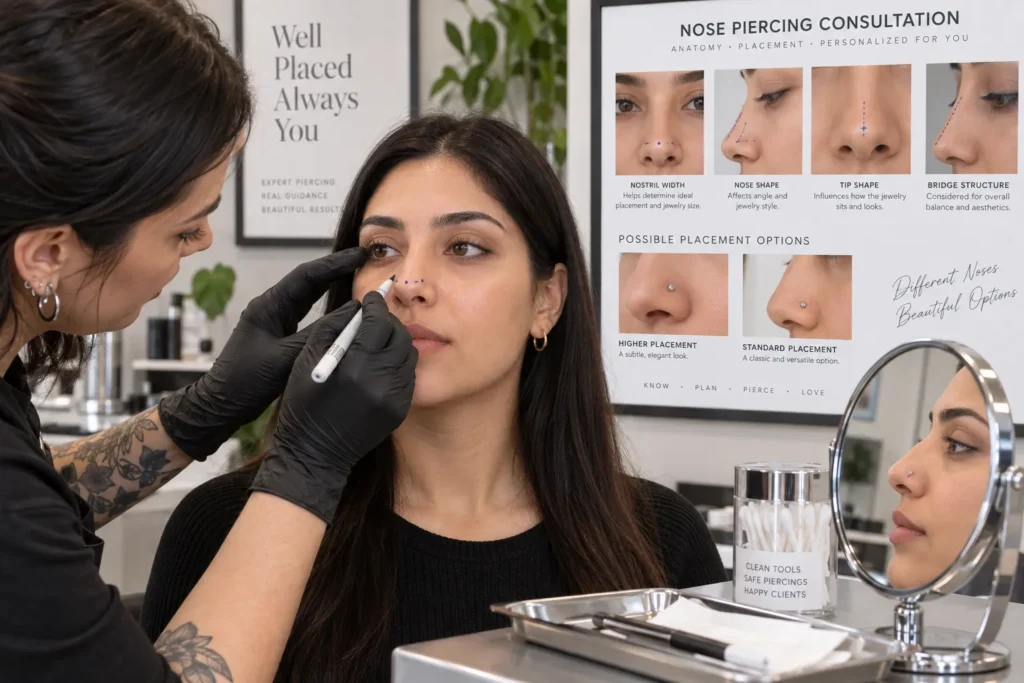
Your nose shape does not decide whether you can be pierced. It changes where jewelry sits and how it looks from the front and the side.
A piercer judges that on your own anatomy, so use the points below as questions for a consultation.
Shape names describe the tip and the bridge.
A button nose has a small, rounded tip with a slight upturn. A snub nose has a short, upturned tip, and a Greek nose has a straight bridge that runs into the tip.
Each profile can change how a stud or hoop sits.
See button nose vs snub nose and button nose types to compare shapes.
Ask your piercer to mark two or three spots. Check each one in a mirror from the front and the side before the needle goes in.
Our placement guide and piercing by nose shape guide go deeper.
If you have had rhinoplasty, ask your surgeon before booking.
Our guide to piercings after rhinoplasty covers timing.
Your Next Step
Start with the healing timeline, since it sets what the first months look like.
Then check a piercer’s standards on the APP locator and ask what metal they use.
Book only when you feel well.
If a current piercing shows signs of infection, see a doctor before you change anything.
Our guide to nose piercings for men covers the most popular placements and workplace-friendly styles.
Our retainer guide explains how to hide your piercing for work, surgery, or sports.
Our guide to what a nose piercing means explores the cultural history and modern symbolism.
Frequently Asked Questions
How much does it cost to get your nose pierced?
Most US studios charge about $50 to $100 for a nostril piercing with basic jewelry, according to Fash.
Bustle puts the piercing fee alone at $30 to $60, with implant-grade jewelry starting near $40.
High nostril and other complex placements cost more, and gold or gemstone jewelry adds more.
Treat these figures as planning ranges, since each studio sets its own prices.
How do I know a piercer is qualified?
The APP says required training and studio regulation vary by location, so you cannot assume standards are in place.
Search the APP member locator, and ask about single-use sterile needles and autoclave sterilization.
Walk away from any studio that uses a piercing gun.
Does getting your nose pierced hurt?
Pain during the piercing varies by person and by placement.
Fash says high nostril piercings tend to hurt more than a standard nostril.
Afterward, Cleveland Clinic says to expect mild pain, redness, and clear fluid that ease within a few days.
How can I tell an infection from normal healing?
Normal healing brings mild soreness, redness, and clear fluid that dries into a crust, according to Cleveland Clinic.
Infection brings worsening swelling, pain, warmth, and thick yellow pus.
Call a doctor if you have a fever or if symptoms get worse instead of better.
Can I change my jewelry early?
Wait until the piercing has fully healed.
Cleveland Clinic says early swaps can get in the way of healing.
Ask your piercer to do the first change so the metal and fit are right.
Does my nose shape change which piercing suits me?
Nose shape affects how a stud or hoop sits, but no shape rules out a piercing.
Nostril width, tip shape, and bridge height all play a part.
A piercer can mark options on your own nose during a consultation.
This guide gives general information and is not medical advice. See a doctor for symptoms or medical questions.